Monday, June 01, 2009

The SVBR: Russia Makes it Modular

Recently there has been a flurry of attention in the English-language blogosphere about the Russians' prospective SVBR reactor series, inspired by this Oil Drum post. While the SVBR development program is hardly new, it has received important endorsements from the Russian government in recent months that suggest that the SVBR reactors will actually see the light of day.

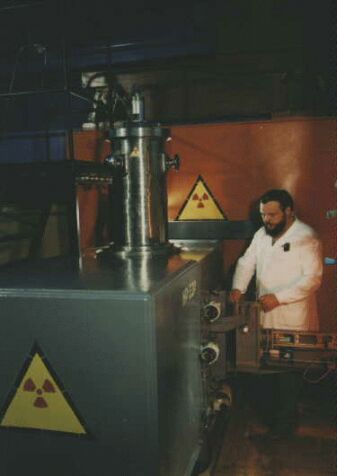
The SVBR-100 reactor.

SVBR stands for Svintsovo-vismutovyi bystryi reaktor, or in English "Lead-Bismuth Fast Reactor." And this is exactly what the SLBR is--an evolved version of the lead-bismuth fast reactor which powered the Alpha submarine. The SVBR is one of three liquid-metal-cooled reators currently under development in Russia, along with the sodium-cooled BN-series and the lead-cooled BREST. Unlike the lead- and sodium-cooled reactors, which Rosatom ultimately envisions as very large (1600+ MWe in the case of the case of the BN-series), the SVBR is designed as a small, modular, and passively-safe reactor.

The reason I think that this is interesting is because I am convinced that such relatively small modular reactors are the future of nuclear power, and the SLBR is the Russian entry into this field, along with the Pebble-Bed Modular Reactor, the NuScale, and others. Furthermore, with Moscow's support the SLBR has better odds going for it than most of the other perspective modular designs.

The SVBR is currently envisioned in three sizes: 10MWe, 75MWe, and 100MWe. The first is intended for various portable and remote uses, incuding electricity and heat. (Ironically, I believe that the SVBR-10 meets Amory Lovins' definition of "micropower.") The 75MWe version was conceived as a way of reusing the equipment at aging Russian VVER-440 reactors. As described here, four SVBR-75 modules will replace the characteristic VVER steam generators within existing plant buildings and take advantage of existing turbomachinery. It's a very elegant idea, and it's easy to see why such a proposal would appeal to Rosatom. Finally, the SVBR-100 would be used in various stand-alone applications, including combined-heat-and-power and clustered in groups to create large power plants.

According to its designers, the SVBR will possess passive safety thanks to its "monobloc" design which incorporates the entire primary coolant loop in the reactor vessel, the physical and nuclear characteristics of the lead-bismuth coolant, and the placement of the reactor vessel in a pool of water which will serve as a passive emergency cooling system. The arguments for the SVBR's safety are, in my view, quite convincing, and it is clearly much safer than the current VVERs and the BN-series. I have my doubts, however, about whether the lead-bismuth coolant is quite friendly enough in operational practice to allow the general civilian application of these reactors. The Alpha submarine program, after all, suffered myriad difficulties with their lead-bismuth reactors and the expectation of widespread use of these reactors in the Soviet navy went unrealized. Gidropress believes that they have solved the attendant materials and design issues associated with lead-bismuth coolant, however. Only when the construction of a prototype SVBR will ascertain whether or not this confidence is justified. Furthermore, bismuth is rare, but geological exploration in Russia has already located enough of the element for hundreds of SVBR reactors.

Besides use repowering VVER-440s and building new electrical and heating plants within Russia, Rosatom also envisions the SVBR as a profitable export item. Anna Kudriavtseva, director of the department of research and scientific-technical policy at Atomenergoprom, reported at a conference last November that the SVBR could conceivably take 10-15% of the world market for small and medium-sized reactors, projected by the IAEA as 500-1000 units by 2040 and a potential value of $600 Billion. To this end the government is investing 16 Billion rubles in the project (about $500 million at current exchange rates), with a view to complete development work by 2017 and to have a pilot plant in operation by 2020. Although certainly less immediate than one might like, it appears that the SVBR will enter the commercial market at around the same time as the PBMR and other competing modular concepts.

Although the cost estimates I can find for the SVBR are not entirely reliable (they are, after all, made for an as-yet undemonstrated reator), they indicate that the SVBR is likely to be more economical than either the VVER or the ruinously expensive BN-series. This makes me wonder why Rosatom's expectations seem to belimited to sales of a few hundred units; barring unforseen events the SVBR would be its most attractive product both within Russia and on the export market by the early 2020s. By then there will probably be enormous demand for an economical, passive-safe nuclear reactor like the SVBR--a demand which Rosatom may be in a highly advantageous position to fill. I am heartened, however, by the fact that the NRC seems to be pondering the adoption of regulations encouraging the development of small, modular reactors. Hopefully the US won't abandon this critical arena to the Russians.

Tuesday, May 05, 2009

Is Joe Romm a "Delayer-1000"?

I'm rapidly losing patience with Joe Romm, whose self-righteous arrogance is, if anything, actually harming the cause of addressing global climate change. Today, Romm published two posts on his blog illustrating the shortcomings of his methods and outlook.

The first, Memo to James Hansen: Your opposition to Waxman-Markey is ill-conceived and unhelpful, is the latest in Romm's series of critiques of James Hansen, the world's most prominent authority on climate change. Romm opines that:
"Why oh why do even smart people like NASA’s James Hansen think that there is such a thing as “simple carbon tax”? Have you folks ever looked at the friggin’ tax code?"
Besides denigrating Hansen, Romm apparently considers it obvious that there is only one credible solution to climate change--socialism: "There is only one way. That is a WWII-style and WWII-scale government-led mobilization." Despite this rather ambitious goal, Romm dismisses a carbon tax as "a political dead end." Are you kidding me? A carbon tax is infinitely more politically acceptable to the American electorate than state control of most of the economy (and that was what state-led WWII economic mobilization consisted of.) Furthermore, Hansen is right that the courts are really the best (and probably only) hope for substantial action on carbon reduction. Perhaps Romm is blind, but the Senate is never going to pass a bill that will reduce emissions substantially anytime soon, much less socialize the economy.

On the bright side, however, Romm's inane critiques of Hansen only serve to undermine his credibility. Anyone with sense can tell the difference between a brilliant, world-renowned scientist and an insufferable, politically intolerant and self-righteous blogger.

In another post Romm used Progress Energy's recent announcement that it will delay its new reactor builds by two years to crow about the supposed uselessness of nuclear power to combat climate change:
I’ll cast an even more positive light on the project delay. Maybe it will give Florida regulators or utility executives time to figure out that other options would be superior.
Well, I've got news for you, Joe. Turns out that those executives and regulators are way ahead of you. And you're dead wrong. Your three proposed alternatives: efficiency, biomass, and CSP, are no alternative to the new nuclear units.

Despite the fact that Amory Lovins' sophistry has deluded many into believing that "efficiency" is baseload power, this is nonsense. Efficiency does not generate electricity: it merely uses it more efficiently. When faced with the challenge of decarbonizing their electrical generation over the next few decades, Florida utilities have to address the prospect of how they will provide reliable, around the clock power even under adverse conditions to a growing population in a carbon-constrained world. Efficiency is important and worthwhile, but because it conserves energy rather than produces it, it does not allow FPL and Progress to avoid the sticky question of how they will generate electricity 25 years from now.

Last year the Florida Public Service Commission issued a study examining the feasibility of implementing a Renewable Portfolio Standard in the state. This study is the most complete comparison of the costs and possibilities of renewable and conventional energy I have ever seen. It compares the costs of different forms of generation across a spectrum of scenarios, using the Florida utilities' actual capital cost projections for these technologies. The results are sobering, as they show that renewables, particularly solar and wind, are not going to be cheaper than new nuclear plants in Florida except with large government subsidies. Biomass is another story, as it is projected to be cheaper than nuclear. However, biomass potential is limited by the availability of sustainable biomass feedstock. Furthermore, several form of "biomass" included in the analysis are not carbon-neutral, such as municipal solid waste burning. As nearly half of the 13,750MW of solid biomass feedstock available per year is from devoting existing farmland to energy crops, it should be readily apparent that biomass is not really an easy, "renewable" alternative to new nuclear plants for Florida. There just isn't enough feedstock for biomass to provide the entirety of Florida's baseload generation needs in coming decades.

Finally, the Florida PSC's study clearly shows that concentrating solar power (CSP, or "solar baseload" in Romm's insufferable newspeak) is an absolute loser in Florida. It is projected to cost more than nuclear power, and indeed more than anything, including all other forms of renewable energy. With generous subsidies the study found that CSP might come in at a little over 16 cents/kW-hr, but under pessimistic assumptions it would cost well over 30 cents/kW-hr.

The Navigant study, significantly, was actually made to support the Florida PSC's Renewable Portfolio Standard proposal, which was actually approved a few months ago. The PSC has definitely done its homework, as have Progress and FPL. Anti-nuclear types like Romm like to pretend as if huge utilities are so stupid that they would make multi-billion dollar investments in nuclear plants--investments that will restrict their near term profitability and severely impact their cashflow--without actually investigating alternatives. The fact of the matter is, these new nuclear plants are being built because the utilities see no good intermediate-term alternative. If coal or gas was acceptable, or if renewables were cost-effective, available, and non-intermittent, FPL and Progress would not be pursuing new LWRs. The very same Florida PSC that sent a RPS proposal to the state legislature also approved rate-recovery to build the nuclear plants. Somehow, I doubt that the PSC is confused about the necessity of nuclear power for Florida.

Furthermore, Romm and his certified accountant (and 70s-era coal apologist) associate Craig Severance are playing fast and loose with the nuclear cost estimates. Severance's so-called "analysis" that Romm "published" on his blog is both mendacious and irrelevant to estimating the costs of the new plants in Florida. Firstly, Severance simply chose to ignore the real reason that FPL's and Progress' cost estimates rose so rapidly in 2007-8--that the utilities were prudently and conservatively extending the ongoing increases in construction costs into the 2010s. Severance assumed that costs would continue to escalate beyond these estimates at a similar rate, but due to the global economic downturn and increasing competition in the production of nuclear components such as pressure vessels, construction cost escalation should soon drop precipitously. But the fundamental problem with the Severance "study" is that it uses capital cost assumptions that are in spectacular excess of the way FPL and Progress are actually financing the new builds. Severance assumed a 15% cost of equity, which was in keeping with the 2003 MIT study but is greatly in excess of the 11.85% rate set by the Florida PSC. Over a multi-year period, the difference between 15% and 11.85% interest is enormous. Furthermore, Severance added hugely inflated figures for decommissioning and waste-disposal costs which he essentially fabricated out of whole cloth. Romm's enthusiastic endorsement of this travesty is a testament to both his own pitifully low intellectual standards as well as his desperate desire to avoid owning up to being spectacularly wrong on the nuclear issue.

Romm claims that "The only thing that would decrease risk is not pursuing this nuclear power plant until all of the lower-cost efficiency and renewable options were exhausted." But if Florida pursued this course (which on close inspection isn't actually available), it would be too late. Such a short-sighted approach would leave Florida in the 2020s with a dwindling base of firm generation. Only decisive action now can forestall the likely challenges of the 2020s, and FPL and Progress are taking the most prudent course open to them. Joe Romm is too proud to admit that addressing climate change will probably require some measures that he doesn't care for. That's his right, but in his own way he's as much of a "delayer-1000" as the figures he decries on his blog.

Wednesday, April 22, 2009

Jon Wellinghoff is Blind

Via Joe Romm, some comments from the Obama Administration's pick for head of the Federal Energy Regulatory Commission, Jon Wellinghoff:

“I think [new nuclear expansion] is kind of a theoretical question, because I don’t see anybody building these things, I don’t see anybody having one under construction,” Wellington said.

Building nuclear plants is cost-prohibitive, he said, adding that the last price he saw was more than $7,000 a kilowattmore expensive than solar energy. “Until costs get to some reasonable cost, I don’t think anybody’s going to [talk] that seriously,” he said. “Coal plants are sort of in the same boat, they’re not quite as expensive.”

I guess that Mr. Wellinghoff is blind, because anyone who has actually been paying attention knows that there's gonna be construction starting soon right here in the good ol' USA:
Southern Nuclear has given notice to its main contractors to proceed towards two new reactors at Vogtle. Permissions already in place allow some construction work to begin.
And as Dan Yurman reported here, Progress Energy in Florida and NRG in Texas are moving in the same direction. But this is symptomatic of much more serious problems with Mr. Wellinghoff: from all appearances, he has absolutely no idea what he's talking about.

This quotation gets at the heart of what I mean:

“I think baseload capacity is going to become an anachronism,” he said. “Baseload capacity really used to only mean in an economic dispatch, which you dispatch first, what would be the cheapest thing to do. Well, ultimately wind’s going to be the cheapest thing to do, so you’ll dispatch that first.”He added, “People talk about, ‘Oh, we need baseload.’ It’s like people saying we need more computing power, we need mainframes. We don’t need mainframes, we have distributed computing.”

The technology for renewable energies has come far enough to allow his vision to move forward, he said. For instance, there are systems now available for concentrated solar plants that can provide 15 hours of storage.

“What you have to do, is you have to be able to shape it,” he added. “And if you can shape wind and you can effectively get capacity available for you for all your loads.

“So if you can shape your renewables, you don’t need fossil fuel or nuclear plants to run all the time. And, in fact, most plants running all the time in your system are an impediment because they’re very inflexible. You can’t ramp up and ramp down a nuclear plant. And if you have instead the ability to ramp up and ramp down loads in ways that can shape the entire system, then the old concept of baseload becomes an anachronism.”

Wellinghoff is seriously confused, both in terms of the current status of renewable technology but also in that he's proposing technological frameworks that are currently wishful thinking. I'm not sure what he means by "shaping" wind, but he seems to be proposing making wind's serious inadequacies irrelevant by allowing energy providers to control end-use--an idea currently in vogue but whose popularity I am certain will disintegrate once it starts being implemented widely. The thing is, most (all?) qualified experts dispute the idea that "baseload is an anachronism." Intermittent generators just aren't dispatchable by definition, and once you get past the wishful thinking and do serious analysis, the barriers to making something like wind dispatchable prove much more forbidding than building new nuclear plants.

Here's a pertinent example of some people who don't share Welinghoff's vision: the authors of the DOE study that estimated that the US could generate 30% of its electricity from wind by 2030. As they concluded:
Wind power cannot replace the need for many “capacity resources,” which are generators and dispatchable load that are available to be used when needed to meet peak load. If wind has some capacity value for reliability planning purposes, that should be viewed as a bonus, but not a necessity. Wind is used when it is available, and system reliability planning is then conducted with knowledge of the ELCC of the wind plant. Nevertheless, in some areas of the nation where access to generation and markets that spans wide regions has not developed, the wind integration process could be more challenging.
However, Mr. Wellinghoff's position makes more sense when we consider his background:
Chairman Wellinghoff is an energy law specialist with more than 30 years experience in the field. Before joining FERC, he was in private practice and focused exclusively on client matters related to renewable energy, energy efficiency and distributed generation. While in the private sector, Chairman Wellinghoff represented an array of clients from federal agencies, renewable developers, and large consumers of power to energy efficient product manufacturers and clean energy advocacy organizations.

While in private practice, Chairman Wellinghoff was the primary author of the Nevada Renewable Portfolio Standard (RPS) Act. The Nevada RPS is one of the two states to receive an “A” rating by the Union of Concerned Scientists. In addition, he worked with clients to develop renewable portfolio standards in six other states. The Chairman is considered an expert on the state renewable portfolio process and has lectured extensively on the subject in numerous forums including the Vermont Law School.

Chairman Wellinghoff’s priorities at FERC include opening wholesale electric markets to renewable resources, providing a platform for participation of demand response and other distributed resources in wholesale electric markets including energy efficiency and plug-in hybrid electric vehicles (PHEVs), and promoting greater efficiency in our nation’s energy infrastructure through the institution of advanced technologies and system integration.
So the head of FERC is not merely ignorant (not knowing that the new nuclear projects are breaking ground is totally inexcusable for someone in his position), but he's a technological fantasist who's determined to pick energy winners before they've been tested in the real world. It's rather akin to trying to pick the winning racehorse before it has been born. It makes me glad that FERC isn't powerful enough to actually implement most of this; at this rate, let's hope it stays that way.

Thursday, April 09, 2009

"Solar-Powered City of Tomorrow" Will Probably Be More Nuclear Than Solar

From Time:
An NFL lineman turned visionary developer today is unveiling startlingly ambitious plans for a solar-powered city of tomorrow in southwest Florida's outback, featuring the world's largest photovoltaic solar plant, a truly smart power grid, recharging stations for electric vehicles and a variety of other green innovations. The community of Babcock Ranch is designed to break new frontiers in sustainable development, quite a shift for a state that has never been sustainable and lately hasn't had much development.
Where will the power for this "green" city come from?
Kitson has been promising unprecedented sustainability all along, but today's shocker was the announcement of Florida Power & Light's plan to provide electricity for Babcock Ranch with a 75-megawatt photovoltaic plant nearly twice as big as the current record holder in Germany. Solar power has been slow to catch on in the gas-powered Sunshine State, but FPL hopes to start construction on the 400-acre, $300 million plant by year's end. The utility expects it will provide enough power for Babcock Ranch and beyond.
Furthermore, Time writer Michael Grunwald claims that:
At $4 million per megawatt — FPL estimates the cost to its customers at about 31� per month over the life of the project — it should be more than four times as cost-effective as the nuclear reactors FPL is trying to build near the Florida Keys.
This statement raises the obvious question of why FPL is trying to expand its nuclear capacity if solar photovoltaics are already four times as cost effective. The answer, in fact, is elegantly simple: Grunwald's math is way off. Not only will the solar plant produce power at least twice as costly as that from FPL's new reactors, but thanks to its likely <25% capacity factor and a lack of energy storage, this "solar-powered city of tomorrow" will likely end up consuming more nuclear-generated electricity than solar-generated electricity.

A quick Google search reveals that Grunwald's numbers are simply inaccurate to begin with:
The Babcock Ranch project will cost between $350 million and $400 million, FP&L officials said. Three other solar projects now being built by FP&L will add 31 cents to the average monthly bill of the utility's 4.5 million customers.
Instead of the $4000/kW given by Grunwald, that's $4667-$5333/kW. This is still considerably lower than the estimates that I had seen in studies commissioned by Florida PSC, for instance this one. This study expected ground-mounted single-axis tracking solar PV installations to reach this price point in approximately 2014. Still, even at that point using favorable assumptions electricity from these facilities was projected to cost over $0.20/kW-hr, with government subsidies reducing that price to $0.136-$0.15/kW-hr. Meanwhile, the same study concluded on the basis of equivalent methodology that the new nuclear plants currently being planned in Florida will produce power at a cost of approximately $0.12-$0.13/kW-hr, beginning in 2016. This was assuming the relatively high figure of $7700/kW capital cost for the nuclear plants. The Navigant study does, however, make it absolutely clear why the Florida PSC has adopted the particular set of policies it has by endorsing aggressive pursuit of both nuclear power and some renewables. However, in ALL scenarios it studies nuclear power is cheaper than all forms of solar electricity after 2016, even with government subsidies. Far from being "more than four times as cost-effective as the nuclear reactors FPL is trying to build near the Florida Keys," this plant will ultimately be considerably more expensive.

Furthermore, it will not actually power Babcock Ranch most of the time. As reported by the Miami Herald:
Though researchers are working to create storage capability for sunlight-generated power, solar electricity at present only is available during daytime hours. The concept is FPL's 75-megawatt solar generator will produce more power for the state's electric while the sun shines than the city will use in 24 hours.

''We're going to generate more renewable energy than the city consumes,'' said Kitson spokeswoman Lisa Hall. ``It will be a leader in solar. It's a great opportunity to overcome that storage thing. The carbon footprint is going to be net zero.''

Basically, the solar plant will produce four times as much electricity as is used by the development one-quarter of the time. The majority of the electricity generated by the plant will go out into the grid and be used throughout Florida. At night and when the sun isn't shining brightly enough to produce much power, the city will receive its electricity from the rest of FPL's generation base... including the reactors at Turkey Point. Currently about 19% of FPL's electricity in Florida is generated at Turkey Point and St. Lucie, but with the ongoing uprates and the two new units at Turkey Point this should increase to 30%+. Furthermore, as solar insolation varies considerably between summer and winter, most of the electricity from the solar plant will be produced in the summer. This means that the PV arrays will produce far more electricity than the city will use in the daytime in June, and far less than it needs in the winter and, of course, none whatsoever at night. So it is unavoidable that most of the energy consumed by Babcock Ranch will come from elsewhere on FPL's grid, and given the probable makeup of their generation mix one decade from now, it will use more electricity generated by nuclear reactors than by its own solar plant.

Isn't that just deliciously ironic?

Thursday, March 26, 2009

Nuclear Power: An Indispensable Climate Change Solution

Joe Romm clarifies his position on nuclear power:

Why not more than 1 total wedge of nuclear? Based on a post last year on the Keystone report, to do this by 2050 would require adding globally, an average of 17 plants each year, while building an average of 9 plants a year to replace those that will be retired, for a total of one nuclear plant every two weeks for four decades — plus 10 Yucca Mountains to store the waste. I also doubt it will be among the cheaper options. And the uranium supply and non-proliferation issues for even that scale of deployment are quite serious. See “An introduction to nuclear power.”

Note to all: Do I want to build all those nuclear plants. No. Do I think we could do it without all those nuclear plants. Definitely. Therefore, should I be quoted as saying we “must” build all those nuclear plants, as the Drudge Report has, or even that I propose building all those plants? No. Do I think we will have to swallow a bunch of nuclear plants as part of the grand bargain to make this all possible and that other countries will build most of these? I have no doubt. So it stays in “the solution” for now.

Romm's take on nuclear power is not particularly well-informed, as I've discussed in the past. But examining its limited role in his proposed solution reveals that Romm has not seriously considered the physical limitations associated with his preferred energy options. For political, geographical, and practical reasons, nuclear power must ultimately play a vastly larger role in our energy future than predicted by Romm.

Romm describes his preferred future energy mix as follows:

What's wrong with this picture?

4000 GW wind, 5000 GW solar thermal, 2000 GW solar photovoltaic. This is an increase of two orders of magnitude for wind and three for both types of solar. I notice that the capacity factor assumptions implied by Romm are quite high. Wind turbines are now a fairly mature technology, so its economics are increasingly apparent, but the costs solar thermal and solar photovoltaic are still unclear. But for the sake of argument I'm willing to grant Romm that maybe in 2050 these technologies will be cost-competitive. The important thing is that the qualitative limitations of these sources of energy go far beyond cost. With the possible exception of a handful of exceptionally well-endowed nations, investment in solar and wind can NEVER assure energy security.

Solar and wind generators depends on the ambient energy resources available in the locations where they are installed. There is, of course, no place on earth where the sun shines all the time, and not many where the wind always blows. So these are intermittent resources by nature. But some countries are better-endowed than others. Imagine, if you will, a future world of 2050 with the energy supply specified by Romm. Some nations, such as Russia, would be unable to meet their own generation needs through wind and solar power. They could import electricity from abroad, but they would have to compete with other markets such as India and China for it. Not only would this make energy expensive, but it would also place Russia at the mercy of its energy suppliers. Hostile states could cripple Russia's economy by interrupting its energy supplies. States exporting renewable energy would also have substantial incentive to underproduce to both encourage uncertainty and raise energy prices. There would be little incentive to produce enough energy for the have-nots, especially since electricity transmission would make them largely captive markets, unlike present-day oil importers. Countries without abundant renewable energy resources would therefore have a desperate need for more secure energy supplies.

Hence the reason why nuclear energy is likely to dominate our energy future. Because relatively few nations have the renewable resources needed to support their economies themselves (just how many depends on how these technologies develop), the most logical step for them to take to secure their post-carbon energy security is to invest in nuclear energy infrastructure. They would have every reason to doubt that other countries would build the infrastructure needed to provide them with affordable and reliable energy, as it would be in those states' interest to underfulfill their needs. Even in a world where renewable energy technology could fulfill all of the world's energy needs affordably, geographic realities would make nuclear power more attractive.

I do not actually believe that wind and solar power are cheaper than nuclear, but my point is that the barriers to a world powered by solar and wind are not merely technological, but geographical, political and economic. I do not expect that solar thermal electricity will cost less than nuclear electricity in 2050, but even if it did this would not translate into energy security for most of the world. Only the provision of non-intermittent energy sources with the ability to store months' or years' worth of energy will secure the interests of these nations. And nuclear power fits these requirements.

In 2050, I expect there to be far more than 350-700 GW of new nuclear plants in operation. In fact, I would not be surprised by 5000-6000 GW of new nuclear by this point. Most of this will probably consist of mass-produced Generation IV reactors, including ALMRs, PBMRs, and various kinds of MSRs. Not only can these technologies replace fossil-fuel electrical generation anywhere on earth at reasonable cost, but they also allow nations to stockpile decades or even centuries worth of fuel--meaning that even a war or natural catastrophe could potentially have minimal effect on energy production.

The real-world alternative to this is NOT an idealistic future of cooperation, windmills, and solar panels. It is a dystopian nightmare where most of the world continues to burn coal because they lack the ability to domestically produce or import environmentally benign energy. It is a world wracked by war, catastrophe, and want. Even if the myriad technological problems of renewable energy were solved, the simple geographic fact remains that some nations lack sufficient energy resources, be they oil, gas, sunshine, or wind. For this reason, nuclear power is indispensable for averting climate catastrophe. Those who pretend otherwise, such as Romm, are fooling themselves.

Tuesday, March 24, 2009

Noisome Falsehoods About Three Mile Island

As I expected, the upcoming anniversary of the Three Mile Island Accident has inspired Harvey Wasserman to trot out one of his more dubious perennial deceptions:
People died---and are still dying---at Three Mile Island.

As the thirtieth anniversary of America's most infamous industrial accident approaches, we mourn the deaths that accompanied the biggest string of lies ever told in US industrial history.
Mr. Wasserman does not apparently live with us in the reality-based community, where it is widely understood that radiation release at TMI was minimal, and that the public health impact from radiation was nonexistent. Repeated epidemiological studies have confirmed this (see Hatch et Al., Am. J. Pub. Health 81:719-24 (1991), Talbott et Al., Environmental Health Perspectives 108:545-62 (2000), and so on).

Sadly, Wasserman has some allies in perpetuating his falsehoods:
A study by Columbia University claimed there were no significant health impacts, but its data by some interpretations points in the opposite direction. Investigations by epidemiologist Dr. Stephen Wing of the University of North Carolina, and others, led Wing to warn that the official studies on the health impacts of the accident suffered from “logical and methodological problems.” Studies by Wing and by Arnie Gundersen, a former nuclear industry official, being announced this week at Harrisburg, significantly challenge official pronouncements on both radiation releases and health impacts.

Gundersen, a leading technical expert on nuclear engineering, says: “When I correctly interpreted the containment pressure spike and the doses measured in the environment after the TMI accident, I proved that TMI's releases were about one hundred times higher than the industry and the NRC claim, in part because the containment leaked. This new data supports the epidemiology of Dr. Steve Wing and proves that there really were injuries from the accident. New reactor designs are also effected, as the NRC is using its low assumed release rates to justify decreases in emergency planning and containment design."
The notion that TMI radiation releases were two orders of magnitude higher than official estimates is preposterous. How do we know this?

As a public service, in 1979 the Eastman Kodak Company collected all the unexposed film that it could locate in the area around Three Mile Island and examined it for evidence of radiation-induced fogging. This would provide excellent evidence of even relatively small radiation exposures, because the film would begin fogging at a mere 5 millirem.

Kodak found nothing. As the reputable scientists who have examined the accident since have emphasized, this totally rules out the theory that public exposure was substantially above background.

Wasserman and his ilk, however, have something better than science. They have... ANECDOTES!
Anecdotal evidence among the local human population has been devastating. Large numbers of central Pennsylvanians suffered skin sores and lesions that erupted while they were out of doors as the fallout rained down on them. Many quickly developed large, visible tumors, breathing problems, and a metallic taste in their mouths that matched that experienced by some of the men who dropped the bomb on Hiroshima, and who were exposed to nuclear tests in the south Pacific and Nevada.
...
In March of 1980, I went into the region and compiled a range of interviews clearly indicating widespread health damage done by radiation from the accident. The survey led to the book KILLING OUR OWN, co-authored with Norman Solomon, Robert Alvarez and Eleanor Walters which correlated the damage done at TMI with that suffered during nuclear bomb tests, atomic weapons production, mis-use of medical x-rays, the painting of radium watch dials, uranium mining and milling, radioactive fuel production, failed attempts at waste disposal, and more.

My research at TMI also uncovered a plague of death and disease among the area's wild animals and farm livestock. Entire bee hives expired immediately after the accident, along with a disappearance of birds, many of whom were found scattered dead on the ground. A rash of malformed pets were born and stillborn, including kittens that could not walk and a dog with no eyes. Reproductive rates among the region's cows and horses plummeted.

Much of this was documented by a three-person investigative team from the Baltimore News-American, which made it clear that the problems could only have been caused by radiation.
The plural of anecdote is not "data." The best longitudinal mortality study of TMI was the Talbott et Al. study published in Environmental Health Perspectives in 2003. (EHP 111: 341-348). Following 32,135 individuals who were within five miles of TMI during the accident, the authors followed their mortality rates between 1979 and 1998. Their findings?
In conclusion, the mortality surveillance of this cohort, with a total of almost 20 years of follow-up, provides no consistent evidence that radioactivity released during the TMI accident (estimated maximum and likely gamma exposure) has had a significant impact on the mortality experience of this cohort through 1998. Slight increases in overall mor- tality and overall cancer mortality persist. The findings of increased risk of LHT for males for maximum gamma exposure and in females for background gamma are of interest and merit continued surveillance to deter- mine if the trend continues. With the excep- tion of breast cancer risk and all lymphatic and hematopoietic tissue (LHT) and maximum gamma exposure, no apparent trends were seen with any of the radiation exposure variables. The slight trend for female breast cancer and likely gamma exposure seen in the earlier update is no longer evident.
Basically, Wasserman's claim that the TMI cohort is unstudied is simply a noisome falsehood. Longitudinal studies have simply discredited his preconceived understanding of the accident. But Wasserman's ravings are not what bothers me. I'm more concerned by the fact that there are still people like Steve Wing, who is trying to push the same discredited scaremongering as genuine science. This is an embarrassment to the University of North Carolina and the field of epidemiology. The tactic of presenting "new studies" at a news conference rather than in a peer-reviewed journal is the kind of tactic employed by cold fusion charlatans and other pseudoscientists. We've humored these people far too long; the public needs to learn that the debate is over, and that they lost.

Tuesday, February 24, 2009

NNSA to Remain in DOE

Well, that didn't take long:
The Obama administration has scrapped a plan to study placing U.S. nuclear-weapon research under the control of the Defense Department, Albuquerque, N.M., Mayor Martin Chavez said following a Friday meeting of U.S. mayors and top administration officials (see GSN, Feb. 6).

"I think that one is nipped in the bud," Chavez said after discussing the proposal with Energy Secretary Steven Chu.

It will be interesting to see how DOE changes under this administration--Obama's emphasis on energy issues (and the very large sums for energy and science research he's proposing) imply a need for serious changes in the way DOE is organized and run. Only time will tell how these issues play out.

Friday, February 13, 2009

Down To Earth

Atomstroiexport has issued a new tender for the proposed nuclear complex in Turkey:
Russia's Atomstroiexport has offered to cut the price of power from its planned nuclear power plant in Turkey by 27 percent, the state Anatolian news agency said on Friday.

Atomstroiexport and its partners -- Russia's Inter Rao (IRAO.MM) and Turkey's Park Teknik -- will sell power from the planned plant for $0.1535 kilowatt hour, instead of $0.2116, Anatolian said, citing Duran Gokkaya, general manager of Tetas, the state power company.

Atomstroiexport was the only bidder in a September tender for Turkey's first nuclear license.

I put a fair amount of effort last month into determining why the original tender was so expensive, but details of the bid were not public knowledge. In any case, the Russians have now offered a new price that, while steep, is not unreasonable. We'll see if the Turks take it.

Monday, February 09, 2009

A VERY Special Relationship

A rather shocking revelation published in The Guardian:

The US military has been using Britain's atomic weapons factory to carry out research into its own nuclear warhead programme, according to evidence seen by the Guardian.

US defence officials said that "very valuable" warhead research has taken place at the Atomic Weapons Establishment at Aldermaston in Berkshire as part of an ongoing and secretive deal between the British and American governments.

The Ministry of Defence admitted it is working with the US on the UK's "existing nuclear warhead stockpile and the range of replacement options that might be available" but declined to give any further information.

Basically, this is tantamount to an admission that the RRW is a joint American-British project, with the Atomic Weapons Establishment providing vital assistance with research that the US weapons labs are apparently unequipped to do. This makes sense in light of the British decision to build new Trident subs--after all, the main purpose of the RRW is probably to replace the W88s on the USN's Trident II SSBMs.

This news makes it clear why the RRW program is unlikely to disappear, even if Obama elects to formally cancel it. The RRW is supported by powerful, entrenched interest groups and is likely to be realized eventually, even if it is delayed another ten years or so. The project has apparently been shared with our closest ally, presumably with the condition that the new warhead could be manufactured at AWE for deployment by the RN. If this is any indication, the "special relationship" between America and Britain is stronger than ever.

Friday, February 06, 2009

NNSA to DOD?

Obama's pondering it, apparently:
The Obama administration is considering moving the nation’s federal weapons complex, including New Mexico’s Sandia and Los Alamos national laboratories, under military control, ending decades of civilian oversight.

The Albuquerque Journal, in a copyright story Wednesday, said an internal memo it obtained shows the administration is looking into turning over control of the labs to the Department of Defense. They currently are controlled by the Department of Energy.

The Office of Management and Budget memo, which carried no date, said such a change would not occur until at least 2011.

I'm not sure what this would entail for some of the labs. LLNL and Los Alamos would presumably move to DOD control; but would ORNL remain with DOE while the Y-12 weapons complex moved to DOD? Growing up in Oak Ridge I do think that the current DOE management of the national labs leaves a lot to be desired, but DOD might not make a better home. Perhaps a better idea would be to recreate the old Atomic Energy Commission and delegate DOE's various nuclear functions to it. In my view, DOE's big problem is that it wears far too many conflicting hats; an agency with a narrow nuclear focus might do a better job than DOE dealing with issues ranging from managing the weapons complex to developing advanced nuclear fuel cycles.

Thursday, February 05, 2009

The Soviet "Doomsday Device" Myth


Those of you who watch the History Channel may have come across this clip, which is from a series titled "Secrets of War." The speaker, Victor Suvorov, is the author of a notorious and now wholly-discredited book about the Soviet entry into WWII. I was wondering where this persistent "Soviets planned a doomsday machine" myth came from, and it appears it is simply another of Suvorov's many imaginative fabrications. I can find no Russian-language references to this tale whatsoever, and all the English ones lead back to this "documentary," and to the ever-unreliable Mr. Suvorov. Given what I know about Soviet nuclear war planning (my field of academic specialization) the story is ludicrous on it face, as well. The concept of self-immolation implicit in a doomsday machine like this is absolutely alien to Soviet political and strategic thought. The Soviet "doomsday machine" is no more than a fairy tale to concocted to amuse American basic cable subscribers, nothing more.

Sunday, February 01, 2009

Aqueous Homogenous Reactor Research in US

As I noted in my recent post, the Russians are developing an aqueous homogeneous rector (AHR) for medical isotope production at the Kurchatov Institute and the Institute of Physics and Power Engineering in Obninsk. But as I read a Russian-language article about the problem of Mo-99 production using LEU, I was surprised to discover that the Russians have some American competition.

The resurrected Babcock and Wilcox is developing a 200kW AHR called the Medical Isotope Production System to produce Mo-99 and other isotopes. As described by the September 2008 IAEA report Homogeneous Aqueous Solution Nuclear Reactors for the Production of Mo-99 and other Short Lived Radioisotopes:
Current concepts under consideration include a 200 kW reactor, capable of producing approximately 1,100 six day Ci/week of 99Mo and other useful isotopes. An existing containment structure formerly housing a pool type research reactor at the BWXT facility in Lynchburg, VA, is under consideration for an initial commercial facility (Figure 1). The reactor would contain approximately 150 L of LEU solution and would operate at approximately 80˚C and atmospheric pressure. A new separation/purification facility is envisioned with hot cell capacity for the several separation/purification/packaging and shipping functions as well as a waste management facility.

The recently-published Medical Isotope Production Without Highly Enriched Uranium has more details. B&W hopes to field the MIPS 5-6 years after a radiopharmaceutical partner is identified, but faces a bevy of challenges related not only to the conceptual design of the reactor, but also to the fact that NRC regulations are ambiguous as to the classification of an AHR and its waste stream. They hope to convert an existing containment structure in Lynchburg, Virginia from an old pool-type reactor to house the first unit. B&W is hiring a lead project engineer to manage the development effort. Anyone out there with experience in liquid-fueled reactor design?

UPDATE: B&W has announced a partnership with radiopharmaceutical manufacturer Covidien to develop the MIPS.

Saturday, January 31, 2009

So Much For "Solar Baseload"

One of the most-hyped renewable energy technologies of the moment is CSP--concentrating solar power. Joe Romm, in particular, is an unabashed CSP booster who has gone so far as to claim that CSP will be "the technology that will save humanity" and that this "solar baseload" make new nuclear builds unnecessary. However, CSP is already failing to live up to the hype.

One of the most advertised of the various companies promoting CSP is Ausra. This company was founded by Australians and financed largely by Silicon Valley venture capitalists. Ausra was notable for its excessive braggadocio, claiming that within a few years its technology would be cheaper than all other alternatives. In recent weeks, however, Ausra has essentially admitted that these claims were merely so much hot air. Ausra CEO Robert Fishman announced that Ausra was scaling back its plans to build large plants, instead focusing on equipment sales. According to the Mercury News, "Fishman said Ausra will build small plants for companies that need industrial steam or electricity." So far from building huge CSP plants with storage that could offer a form of baseload power, Ausra is now planning on providing process heat to factories and auxiliary capacity to existing steam plants--a far cry from its ambitious plans a few years ago. Indeed, Ausra is laying off employees whose expertise was in large power plant construction in light of their new strategy.

Ausra still plans to complete its 177MW plant in Carrizo, California, but henceforth it plans to concentrate on decidedly "non-baseload" applications. Whether this business plan will work remains to be seen (efforts to market similar technologies in the 1980s fizzled), but this is a sign that their technology did not live up to expectations. Particularly interesting is the fact that the new applications that Ausra is marketing its collectors for do not involve storage--suggesting that their ambitious plans to store steam geologically were far from the "trump card" they had claimed. Clearly, Ausra is now paying dearly for its hubris.

Although Ausra has been mum on the issue, I have a suspicion that their solar concentrators have probably failed to perform up to expectations. DOE tested similar solar concentrators in the early 1980s and concluded that the cost advantages of the fresnel reflectors weren't worth the tradeoff in reduced performance. If the concentrators had performed well at Ausra's test facilities I suspect that it would be widely advertised in Ausra's marketing, so its reticence (and its difficulty attracting utility-scale orders) suggest some problems in this arena.

While Ausra is far from the only player in the CSP field and as such it ought not be conflated with the entire industry, well-apprised figures say that it is likely that many other firms are in similar straights. "I think it's going to be a brutal, brutal year for solar, and a lot of companies will go out of business," said Andrew Beebe, the CEO of Suntech Energy Solutions, which develops solar-power facilities for corporations and utilities. "A lot of mistakes were made. Now is the time of reckoning, and it's going to be ugly." Far from being poised to save the world, the solar industry is apparently fully occupied trying to save itself.

Friday, January 30, 2009

Will 50% of Nuclear Loan Gurantees Default?

Critics of DOE's loan guarantees for new nuclear construction are fond of pointing out that the Congressional Budget Office reported in 2003 that it expected that "over 50%" of nuclear loans would default. For instance, this piece in the Washington Monthly trots out the figure as a means of pouring cold water on the prospect of new nuclear builds.

But what are the assumptions behind the 50% figure?

To find out it is merely necessary to refer to the CBO website. Reporting on the Energy Policy Act of 2003, the CBO found that:

CBO considers the risk of default on such a loan guarantee to be very high--well above 50 percent. The key factor accounting for this risk is that we expect that the plant would be uneconomic to operate because of its high construction costs, relative to other electricity generation sources. In addition, this project would have significant technical risk because it would be the first of a new generation of nuclear plants, as well as project delay and interruption risk due to licensing and regulatory proceedings.

In its 2003 Annual Energy Outlook, the Energy Information Administration (EIA) projects that production from new nuclear power plants would not be cost-competitive with other power sources until after 2025. EIA also reports that current construction costs for a typical electricity plant range from $536 per kilowatt of capacity for natural-gas-powered combined-cycle technology to $1,367 per kilowatt of capacity for coal-steam technology. Although construction costs could diminish significantly as a new generation of nuclear plants are built, a new nuclear power plant starting construction in 2011 would have a construction cost of about $2,300 per kilowatt of capacity. By 2011, that cost would result in capital costs that are 40 percent to 250 percent above the cost of capital for electricity plants using gas and coal. Because the cost of power from the first of the next generation of new nuclear power plants would likely be significantly above prevailing market rates, we would expect that the plant operators would default on the borrowing that financed its capital costs.

Assuming the nuclear plant is completed, we expect it would financially default soon after beginning operations, however, we expect that the plant would continue to operate and sell power at competitive market rates. Thus, over the plant's expected operating lifetime, its creditors (which could be the federal government) could expect to recover a significant portion of the plant's construction loan. The ability to recover a significant portion of the value of the initial construction loan would offset the high subsidy cost of a federal loan guarantee. Under the Federal Credit Reform Act, funds must be appropriated in advance to cover the subsidy cost of such loan guarantees, measured on a present-value basis. CBO estimates that the net present value of amounts recovered by the government on its loan guarantee from continued plant operations following a default and the project's technical and regulatory risk would result in a subsidy cost of 30 percent or about $375 million over the 2011-2013 period. Based on information from DOE, we expect other loan guarantees would not be issued for nuclear power plants until after 2013.


Basically, the CBO determined that nuclear plants would default because they would be uneconomical compared to conventional coal and natural gas generators. The former, it appears, are not going to be in the picture due to government regulation. The latter's costs will depend considerably on future natural gas cost trends, but by the time new nuclear plants enter operation in the 2018 timeframe chances are that natural gas prices will have returned to high levels due to resurgent worldwide demand. Furthermore, electricity prices are definitely going to go up in the next decade. The EIA is predicting that retail electricity costs will be about 12 cents kw-hr one decade from now. Finally, many of the new nuclear plants are being planned by regulated utilities that can use rate-recovery to finance construction, and so long as they convince regulators that they have incurred costs prudently they are allowed to adjust electricity rates to cover costs. The scenario outlined by the CBO--nuclear being uncompetitive with coal-fired electricty--is exceedingly unlikely to cause a default at a regulated utility, and given projected increases in retail electricity rates, deregulated utilities as well.

The assumptions behind the 50% loan default figure were dubious in 2003 and are indefensible now. It's time to consign this "fact" to the scrap heap.

Thursday, January 29, 2009

The Aqueous Homogeneous Reactor Lives!

I'm a big fan of the aqueous homogeneous reactor. These are nuclear reactors that have their fissile fuel in an aqueous solution, rather than as solid fuel rods. Back in the late 1950s there was a major program at ORNL to try and develop an AHR on the Th-U233 cycle for commercial power production, but extreme corrosion issues resulted in the cancellation of the program. ORNL researchers decided (rightly, in my opinion) that molten-salt reactors were a better idea.

Soviet researchers never attempted to develop AHRs for power production, but they did develop these reactors for a practical application: radioisotope production for medical use, in addition to certain research applications. To this end they developed a series of AHRs culminating in the ARGUS: a miniature AHR producing a mere 20-50 kw thermal.


The ARGUS reactor: it's a wee little beastie


The AHR has two big advantageous for medical isotope production: firstly, its fluid fuel form makes extraction of isotopes from the fuel much simpler than from solid-fuel reactors. Secondly, AHRs have excellent safety characteristics. They have strongly negative temperature and void coefficients, making them essentially self-controlling. However, the corrosion issues associated with uranyl sulphate fuel have resulted in the abandonment of AHR research in most of the world. This is not the case, however, in Russia. In September of last year the Physico-Energetic Institute in Obninsk (normally known as the Institute for Physics and Power Engineering) announced plans to build a new nuclear medicine facility on the basis of a modernized AHR:
На промышленной площадке ГНЦ РФ «Физико-энергетический институт» в г. Обнинске Московской области предлагается создать комплекс по производству радиоизотопов на основе новой технологии с применением растворного реактора малой мощности. Как отметили в ФЭИ, проект растворного реактора для наработки и выделения радиоизотопов непосредственно из топливного раствора является одной из самых существенных разработок, осуществленных с участием радиохимиков. По словам директора отделения изотопов и радиофармпрепаратов ФЭИ Николая Нерозина, проект позволяет использовать реактор малой мощности 50(82) кВт для получения следующих изотопов медицинского назначения: Mo-99, Sr-89, Xe-133, а также смеси изотопов йода.

In the industrial sector of the GNTs RF "Physico-Energetic Institute" in the city of Obninsk, Moscow Oblast, the construction of a complex for the production of radioisotopes on the basis of new technology utilizing a solution reactor of low power is planned. As described by FEI, the project for a solution reactor for the production and extraction of radioisotopes extracted directly from the fuel solution is one of the most significant developments, being carried out with the assistance of radiochemists. In the words of the director of production of isotopes and radiopharmaceuticals Nikolai Nerozin, the project will utilize a reactor of low power 50(82) kWt for the production of the following isotopes with medical uses: Mo-99, Sr-89, Xe-133, and also a variety of isotopes of iodine.
From the published articles I gather that this reactor will be an evolved version of the ARGUS, designed to operate on 20% U-235 rather than the HEU utilized in the original ARGUS. Given the recent economic downturn, these plans for a new AHR in Obninsk may be scrapped, but clearly the researchers at the Kurchatov Institute and IPPE believe that the AHR is the solution to the worldwide problem of producing radioistopes for nuclear medicine without resorting to reactors using HEU. Personally, I wish them all the success in the world.

Wednesday, January 21, 2009

Just Say No to Portfolio Standards

The latest regulatory boondoggle, this time from Illinois:
Omaha-based energy company Tenaska Inc. plans to move forward with building a $3.5 billion clean-coal plant in Illinois after the Illinois General Assembly passed the Clean Coal Portfolio Standard Act.

The new legislation would require large utilities in the state to enter into long-term contracts to buy up to 5 percent of their electricity from clean-coal facilities, such as Tenaska's Taylorville Energy Center in Taylorville, Ill., said Bart Ford, vice president of business development at Tenaska.

Clean-coal facilities must capture at least 50 percent of their greenhouse gas emissions in order to qualify.
This is the stupidest thing I've ever heard. But then again, it makes as much sense as portfolio standards for renewables, or nuclear power, or anything else. The problem with portfolio standards is that they are corporaratist giveaways to the manufacturers of various technologies, which mandate the use of certain options whether they make physical, economic, and environmental sense or not. Portfolio standards are bad policy and will not be an effective substitute for carbon pricing. The sooner our country's leaders realize this, the better.

Monday, January 19, 2009

Russia Seeks Japanese Nuclear Plant

From The Japan Times:
The government plans to send senior officials to Moscow for final-stageLink negotiations on concluding a bilateral civil nuclear cooperation agreement with Russia, government sources said Saturday.

The move, which could happen later this month, is part of efforts to settle the matter before Russian Prime Minister Vladimir Putin visits Japan, taking into consideration that Putin is placing importance on energy. No date has been set for the trip.

The plan expected to pave the way exporting a modern nuclear power plant to Russia. The Japanese government's initial plan was to conclude the deal if Putin visited Japan by the end of 2008. But the visit was scratched by the global financial crisis, and the talks remain in limbo.

In past negotiations, Japan and Russia have clashed over involvement by the International Atomic Energy Agency. Japan is demanding the agency conduct a "strict examination" of Russia's nuclear facilities to confirm the plant will be used for peaceful purposes. Russia showed reluctance by insisting the country is already a nuclear power, the sources said.

Since Japan will field its own candidate this fall to take over the U.N. nuclear watchdog, the government is expected to continue to press Russia to accept the demand so it can gain support from other countries in the election.

The idea of Russia importing Japanese nuclear power plants is an old one--it was first floated in the 1970s when the USSR was experiencing great difficulty building VVER-1000 pressure vessels. My guess, however, is that Russia may be interested in acquiring more modern technology to bolster their nuclear export business. Currently, Rosatom can only sell its reactors to former Soviet satellites and developing countries. But if Rosatom licensed more modern technology, it could conceivably market its wares in the first world while undercutting Japanese and European vendors on price--potentially winning profitable new markets for Russia, while avoiding the need to develop a new LWR itself.

Note that Russia's primary next-generation reactor effort--the BN-series liquid-metal fast breeder--cannot be exported for proliferation reasons, in addition to the fact that it will probably prove economically uncompetitive with LWRs. So the royal road for Russia to compete in the global nuclear reactor market in the intermediate term is to import foreign technology. (Note that China and Britain are basically doing the same thing with their plans to start building AP1000s domestically). Especially worrisome (for Rosatom) is that cost trends suggest that its latest version of the VVER-1000 is probably going to be only slightly cheaper than reactors like the AP1000, so it really needs to come up with a strategy to compete in the global nuclear market after the 2020 time frame. But I'm not quite sure what's in it for the Japanese.

Thursday, January 08, 2009

A Federal RPS: A Very Bad Idea

However thrilled I am about Obama's choice of Steve Chu as Secretary of Energy, I am not exactly thrilled by the proposals being put forth by the transition regarding energy policy. Take, for instance, this component of Obama's stimulus proposal:
Obama and Biden will create a federal Renewable Portfolio Standard (RPS) that will require 25 percent of American electricity be derived from renewable sources by 2025, which has the potential to create hundreds of thousands of new jobs.
A federal RPS is simply bad policy, for a variety of reasons:

1) It's inequitable. Because different parts of the country vary enormously in their renewable energy potential, some parts of the country (such as my native Tennessee) would probably never be able to meet the 25% standard, even if cost were no object. I imagine that there will be some kind of trading scheme to address this imbalance, but it will both place enormous pressure on more endowed areas of the country to overinvest in renewable generation, and also increase the cost of compliance for have-nots. Therefore, to the extent that renewable portfolio standards are good policy (which I don't think they are) they should really only be mandated on a state-by-state basis.

2) It's economically inefficient. Unlike carbon pricing, a RPS does not encourage end-users to change their preferences in light of environmental externalities, but rather forces utilities to purchase power from sources that may not be appropriate. The need to meet targets will also create a massive distortions, allowing the renewable energy industry to increase their prices and making their product more expensive than it needs to be. This deprives other possible carbon-mitigation measures, from efficiency to nuclear power, of capital that would be more efficiently invested in them.

3) It's probably unattainable, given European experience with similar policies. The UK's decision to pursue new nuclear power plants resulted from a politically unpopular discovery that even in windy Britain, renewable energy just doesn't live up to the hype. Despite the DOE's report that wind could provide 20% of US electricity by 2030, this estimate is based on extremely optimistic assumptions that seem thoroughly debunked by European experience. Keep in mind that US electricity use will probably grow at least some by 2025, so growing from current US renewable capacity to 25% would involve a near-unimaginable number of new generators--given average capacity factors for solar and wind generators, probably 4x or more the size of the current US nuclear fleet in terms of nameplate capacity, in just over 15 years.

On the whole, a federal RPS is a boondoggle that will misallocate resources and distract attention from more efficient and effective means of combating global warming. I will grant, however, that it would probably live up to its promise to "create hundreds of thousands of jobs"--but only at the expense of being an enormous drag on the economy, in addition to huge federal subsidies. As the stimulus also promises:
They [Obama and Biden] will also extend the Production Tax Credit, a credit used successfully by American farmers and investors to increase renewable energy production and create new local jobs.
If renewable energy is a sensible investment, carbon pricing will be all that is necessary to expand its utilization to an appropriate level. If renewable energy is such a good idea, why is it necessary for the government to force people to buy it? Carbon pricing, whether cap-and-trade or a carbon tax, is a much more appropriate policy for addressing climate change. A federal RPS is simply a very bad idea.

Tuesday, January 06, 2009

Are Gen III+ Nukes "Prudent?"

The latest critique of building new nuclear power plants, Craig Severance's Business Risks and Costs of New Nuclear Power, has created quite a buzz. Severance comes to the conclusion that the "most likely" cost of electricity from new Gen III+ plants is an eye-popping 30 cents kw-hr. On this basis, he charges that new nuclear plants are not a good investment for utilities, and that capital should be invested elsewhere.

In his conclusion, he states that:
The goal should be a reliable and cost effective utility network. This is the goal – not a particular type of power plant or a particular set of plans to defend.

Utility management shouldn’t be too exciting. If an idea starts to look like it could have excessive business risks and costs, it is best to re-assess and find less risky ways to meet the goals. The last generation of utility managers nationwide reached this conclusion about nuclear power. This Paper has shown reasons why these executives were right, even though they had to cancel nuclear plans they themselves, plus a powerful nuclear lobby and a pro-nuclear government, had at one point advanced.

If current-day utility executives and utility regulators will now consider these facts, the nation can proceed to address the energy challenges we face, with far less rancor and risks, and lower costs overall, than if a futile attempt is made at great cost to revive a nuclear industry that has never kept its promises to provide a competitive and viable generation source.
The problem here is that utility executives do not have any kind of single-minded determination to pursue nuclear power at any cost. In fact, most of the utilities planning new nuclear builds are doing so not because they are stricken with an "irrational exuberance" they need to be disabused of, but because of the need to prepare for a carbon-constrained future. If the prospect of carbon pricing wasn't looming, no one would be pursuing new nuclear plants.

To understand why building new nuclear plants is a prudent decision for a utility to make, we have to think ahead, to what conditions might possibly be like in the 2020s. In light of carbon pricing, old coal plants will either have to limit their operation or shut down entirely. Those that do operate will be expensive (as this is the entire purpose of carbon pricing). Even with license extensions older nuclear plants will be reaching the end of their operational lifetimes. This will open a very important qualitative gap in the generation mix of the utilities thinking about new nuclear builds.

Much like Amory Lovins, Severance makes the erroneous assumption that a kw-hr is a kw-hr, no matter what, and we should simply select the very cheapest generation option and be done with it. But this raises an important question--why do utilities invest in generators that don't have the lowest available lifetime cost? In other words, why did they invest in gas turbines and not coal plants?

The answer, of course, is that utilities have to provide power when and where it is wanted, and demand is not constant. Different technologies vary considerably in their ability to adjust to rapid changes in load. As circumstances have it, only two technologies in widespread use really lend themselves to peak power generation--hydroelectric dams and gas turbines. It is unlikely that many more of the former will ever be built in this country; the latter were the great winner in the energy field in recent decades. But gas has high operating costs, which discourages its use for off-peak generation. Baseload power is produced by coal and nuclear plants, which serve as the foundation of the generating capacity of many utilities. Basically, any policy to address climate change will tear the heart of these utilities' generating fleets, and the new nuclear units are a hedge to avoid this possibility.

Since a carbon-pricing scheme will force the utilities to close their amortized coal plants, they need to plan new baseload capacity to be available to keep providing reliable services. And right now, new nuclear plants are the only available option available for this role. Of course, this claim is disputed by renewable-energy enthusiasts, but the most currently hyped "baseload" renewable option--concentrated solar thermal--will not work in most of the areas considering new nuclear plants, due to want of direct sunlight. These areas generally lack geothermal and wind resources as well, although the latter don't constitute a real "baseload" source in any case. Fanciful proposals to build huge CSP plants in the southwest and transmit the power east of the Mississippi are not realistic alternatives to nuclear reactors for utilities in places like South Carolina. For all the barriers to building a new nuclear plant, they are minuscule compared to the technical and legal barriers facing such a scheme.

It is possible to use natural gas for baseload. Indeed, this is how most electricity in Russia is generated. But the example of Russia neatly illustrates why increased reliance on natural gas is ill-advised. Firstly, electricity in Russia is expensive and in short supply; and secondly, the Russian government is determined to maximize revenue from gas exports, and therefor drive up world prices. For these reasons, the Russians are planning to nearly double the size of their domestic nuclear fleet in the next ten years and are betting the long-term future of their electricity sector on nuclear power.

Of course, no one in their right mind would build generating capacity as expensive as Severance's 30 cent/kw-hr figure. This figure is in "nominal" dollars--essentially, a value from ten years in the future inflated from present dollars, and so would be lower in 2009 terms. But the reason that companies like Progress and FPL are ordering new plants is that they will not cost this much. Part of the reason for this is that Severance has used excessively pessimistic estimates for aspects of the nuclear fuel cycle for mining, milling, enrichment, waste disposal and decommissioning. Another reason the 30-cent figure is an overestimate is because Severance makes the assumption that the massive run-up in nuclear construction cost estimates between 2000 and 2008 will continue until the end of the next decade, nearly doubling construction costs. There is no good reason to believe this, given the recent collapse in commodities prices and the probable near-term global increase in the number of nuclear component vendors. Finally, Severance assumes a 14.5% average cost of capital, but regulated utilities in Florida and South Carolina are expecting to use rate recovery to finance plant construction, resulting in far lower capital costs. So the power generated by these plants will cost nowhere near 30 cents kw-hr. Just how much will depend on the degree of construction cost escalation and the cost of capital, but I expect a final figure in the 11-15 cents kw-hr range.

This is admittedly not cheap, although ten years from now this will probably be fairly competitive in the electrical generation field. I myself, and many readers of this blog, are confident that with a concerted effort we can develop nuclear plants in the next decade with vastly lower capital and operations costs than Gen III+ LWRs. Still, at the moment these utilities have no better options. These nuclear plants are not premised on massive future demand growth; they are are premised upon massive future generation loss. They cannot reasonably expect any technology--be it wind, "clean coal," or, sadly, Gen-IV nuclear--to be available in the next fifteen years to avoid the need for these new units. Right now, the utilities can either order new nuclear plants or risk being left without the ability to provide reliable service in the 2020s. They've chosen the former. And that's just prudent.

Saturday, January 03, 2009

Time Magazine on New Nukes

From Going Nuclear, by Micheal Grunwald:
Nuclear power is on the verge of a remarkable comeback. It's been three decades since an American utility ordered a nuclear plant, but 35 new reactors are now in the planning stage. The byzantine regulatory process that helped paralyze the industry for a generation has been streamlined. There hasn't been a serious nuclear accident in the U.S. since the Three Mile Island meltdown in 1979. And no-nukes politics has become a distant memory. It was a sign of the times when John McCain ridiculed Barack Obama for opposing nuclear energy--and the allegation wasn't even true. "There's only a very small minority in Congress that still opposes nuclear power," says Alex Flint, the top lobbyist at the Nuclear Energy Institute (NEI). "That's quite a change."
...
So how should we produce our juice? The answer may sound a bit unsatisfying: more wind, less coal but mostly the same electricity sources we're using, until something better comes along. The key will be reducing demand through energy efficiency and conservation. Most efficiency improvements have been priced at 1¢ to 3¢ per kilowatt-hour, while new nuclear energy is on track to cost 15¢ to 20¢ per kilowatt-hour. And no nuclear plant has ever been completed on budget.

It appears that the author's conclusions were influenced by our old friend Amory Lovins:
Energy maven Amory Lovins has calculated that, overall, new nuclear wattage would cost more than twice as much as coal or gas and nearly three times as much as wind--and that calculation was made before nuclear-construction costs exploded.
Indeed, he provides plenty of unreferenced RMI talking points [link mine]:
A Warren Buffett--owned company has scrapped plans for an Idaho nuclear plant; banks and bond-rating agencies are skeptical as well. In fact, renewables attracted $71 billion globally in private capital during 2007 while nukes got zero. The reactors under construction around the world are all government-financed. "I have to keep explaining: France and China are not capitalist countries!" says Congressman Ed Markey, an antinuclear Massachusetts Democrat. "Nobody wants to put their own money into this so-called renaissance--just ours."
Of course, the truth behind this is rather more complex. Buffett dropped his plans to build a plant in Idaho--only to turn around and buy Constellation, which owns five reactors and is planning to build more, beginning with Calvert Cliffs 3 in Maryland. Investment in nukes is definitely non-zero, as is evidenced by companies such as Hyperion and NuScale, among others. This also makes it sound as if renewables are never financed with government funds, when it's clear from the renewble industry's own lobbying that they lead a hand-to-mouth existence on the basis of government subsidies. Take, for instance, this Time piece from a few months ago:
In a press conference last week the leaders of the solar, wind, geothermal and hydropower industries called on Obama and the incoming Congress to look ahead. First, energy leaders asked Obama to immediately adjust the alternative-energy production credit to provide green investors with a cash rebate, rather than a tax reduction. With the economy tanking, simple tax credits — which Congress renewed in October and without which the renewable-energy industry would not survive — aren't the lure they once were for companies looking to invest in new energy projects.
This gives a much more realistic picture of the situation. Worldwide, the renewables industry benefits from mandates, feed-in-tarriffs, and similar distortions that render utterly meaningless any appeal to the "wisdom of the market" in comparing new nuclear capacity and renewables in terms of gloabl investment. As the leaders of the industry themselves make clear, private investors put money into their businesses because they are a spectacular opportunity for rent-seeking. But I digress.