Thursday, May 22, 2008

Podvig on US-Russia Civil Nuclear Cooperation

From a column in BAS:

Two weeks ago, the United States and Russia signed an agreement on civilian nuclear cooperation, commonly known as a "123 agreement." It was immediately attacked from all sides. Some members of Congress urged the Bush administration not to submit the document to Congress and threatened to block it once they did. Meanwhile, nuclear skeptics in Russia raised concerns that the agreement could revitalize the idea of importing foreign spent nuclear fuel into Russia or strengthen the U.S.-led Global Nuclear Energy Partnership. For their part, U.S. nuclear enthusiasts suspected Russia of attempting to gain access to advanced U.S. nuclear technologies, which, they argued, Moscow could use to establish a competitive advantage in the international nuclear trade.

There are many good reasons why such a nuclear deal should receive scrutiny and raise questions, but in this case, the opponents of the U.S.-Russian agreement are wrong. Whatever their concerns, blocking the cooperation agreement is the worst way to address them.

I'm in general agreement with this. A particular statement in the piece caught my eye:

The Russian public may be sympathetic to using the spent fuel to recover plutonium and produce electricity--a grand vision promoted by the Russian nuclear industry--but it's not ready to accept the idea of permanently burying nuclear waste somewhere in Siberia.

Go read the whole thing.

Saturday, May 17, 2008

In Case of Nuclear War, Take...


Аптечка индивидуальная АИ-2

This item, available now on eBay for the princely sum of $35, is an example of the first aid kit stockpiled by the Soviet Union during the 1970s and 1980s to distribute to ordinary individuals in case of nuclear war. The ominous-looking black thing at the top is a single-use morphine syringe. Quite a few of these little orange kits seem to have been made, and they were featured fairly prominently in Soviet civil defense propaganda.

Wednesday, May 14, 2008

With This Missile, India Can Even Strike Shanghai

From The Times of India:
India's long-range nuclear capable Agni-III missile, which was successfully tested on Wednesday, is not aimed at any particular country but can hit targets deep inside China or any West Asian country, according to Group Captain R K Das, spokesperson of the Indian Army's Eastern Command.

"The Agni-III is not country-specific but was test-fired to strengthen our military power. With the successful launch of the missile, India has joined the league of global superpowers like China, France, Russia, US and UK who already have this type of weapons in their possession," Das said here Wednesday evening.

He said: "With this missile, India can even strike Shanghai. Agni-III was developed indigenously by scientists in India. The research and development activity of the missile had been on for the past eight years."

India successfully test-fired the 3,000 km range surface-to-surface nuclear capable missile from Wheeler's Island off the Orissa coast Wednesday morning.

"We can't let ourselves be unprotected. We have built a capability to retaliate if we are threatened. This missile would help India form a credible defence from China. With this launch, China will think twice before attacking us," Das said.

Who said the arms race was over?

Tuesday, May 13, 2008

20% Wind By 2030?

The DOE issued a report today claiming that the US can generate 20% of its electricity with wind by 2030 without tax credits and without running into serious grid-balancing problems. While the report has received a lot of praise from the likes of Joe Romm and Ezra Klein, among others, I have to say that it left me somewhat incredulous.

What bothers me is the contention that the variability of wind really doesn't matter. According to the report:
A statistical analysis of the load net of wind indicates the amount of reserves needed to cope with the combination of wind and load variability. The reserve determination starts with the assumption that wind generation and load levels are independent variables. The resultant variability is the square root of the sum of the squares of the individual variables (rather than the arithmetic sum). This means that the system operator, who must balance the total system, needs a much smaller amount of reserves to balance the load net of wind. Higher reserves would be needed if that operator were to try to balance the output of individual wind plants, or all the wind plants aggregated together in isolation from the load.

For a concrete case, it offers:
A hypothetical example is offered to calculate reserve requirements. Say that system peak load for tomorrow is projected at 1,000 MW with a 2% forecast error, which makes the forecast error (i.e., expected variability of peak load) equal to 20 MW. Wind generation for a 200-MW wind plant in that balancing area is predicted at a peak hour output of 100 MW with an error band of 20%. The expected variability of peak wind generation, then, is 20 MW. Assuming that these are independent variables, the total error is calculated as the square root of the sum of the squares of the individual variables (which is the square root of 2 × 20 squared, or 1.41 × 20, which equals 28 MW). Adding the two variables to estimate reserve requirements would result in an incorrect value of 40 MW.

The problem is, wind doesn't really work this way. The "expected variability of peak generation" is an estimate. Even with very good forecasting techniques, it's sometimes going to be too small. In any case, you need enough dispatchable reserve to make up for shortfalls in relatively extreme situations--and in a grid with 20% wind, that means enough natural gas or hydropower to make up nearly all the variability. I'm also disturbed that the report talks a lot about hypothetical "studies" while paying very little attention to real-world experience with wind power in Europe. Far from the rosy picture painted in the report, countries like Denmark have not really gotten their money's worth out of their investment in wind power--see, for instance, this study of how Denmark balances its power grid in practice. It concluded that:
Denmark has the most intense wind carpet in the world, with a total of 3000 MW installed by the end of 2003— equivalent to 0.88 kW of wind energy per person in west Denmark. The average annual load factor for the wind turbine carpet in west Denmark is measured at approximately 20%. There are considerable and often rapid output variations throughout the day and throughout the year. Accurate forecasting of wind speeds is still difficult and output rarely matches demand, sometimes dropping below zero as stalled wind turbines still require power for their steering systems.

The variations, which are inherent in any wind energy system, can be readily accommodated in west Denmark because there are very strong electrical connections to the much larger grid systems of Norway, Sweden and Germany that can absorb these variations, particularly due to their reliance on rapid-reacting hydropower. Countries such as the UK, which operate an ‘island’ grid, will find it difficult to do this with slower-reacting thermal power stations and may thus have to limit their reliance on wind power.

If this is any indication, the DOE report vastly underestimates the challenges of integrating large amounts of wind generation into our power grid. To their credit, though, they do get this much right:
Reliability planning entails determining how much generation capacity of what type is needed to meet specified goals. Because wind is not a capacity resource, it does not require 100% backup to ensure replacement capacity when the wind is not blowing. Although 12,000 MW of wind capacity have been installed in the United States, little or no backup capacity for wind energy has been added to date. Capacity in the form of combustion turbines or combined cycle units has been added to meet system reliability requirements for serving load. Thinking in terms of “backing up” the wind is not appropriate because the wind capacity was installed to generate, low-emissions energy but not to meet load growth requirements. Wind power cannot replace the need for many “capacity resources,” which are generators and dispatchable load that are available to be used when needed to meet peak load. If wind has some capacity value for reliability planning purposes, that should be viewed as a bonus, but not a necessity. Wind is used when it is available, and system reliability planning is then conducted with knowledge of the ELCC of the wind plant. Nevertheless, in some areas of the nation where access to generation and markets that spans wide regions has not developed, the wind integration process could be more challenging.

Translation: Wind can "work" because it's not expected to substitute for baseload: i.e., even building 300GW of new wind turbines will not obviate the need to build new nuclear plants to provide carbon-friendly dispatchable baseload power.

Friday, May 09, 2008

What Do Putin's Liberal Russian Opponents Think of His Nuclear Policies?

The answer may surprise you.
Boris Nemtsov is an important figure in Russia's liberal opposition movement. He was Deputy Prime Minister of Russia during the late 1990s under Yeltsin. Nemtsov was one of the founders, and now the main spokesperson of, the Union of Right Forces. Despite its ominous-sounding name, the Union of Right Forces is one of Russia's two main liberal opposition parties, along with the more left-leaning Yabloko. Nemtsov, in particular, is the proponent of a particular brand of Russian liberal thought that is as suspicious of the west as it is disapproving of Putin.

This outlook led Nemtsov to make a critique of Putin's nuclear weapons policies that will surprise most westerners. In his recent "White Paper" in which he critiques the legacy of Putin's presidency at length, Nemtsov claims that Putin has allowed a catastrophic decline in the quality of Russia's nuclear deterrent, and that that this threatens Russia's national survival:
This was the time to arm the army adequately. However actual arms deliveries and even plans for re-equipment have been scandalously low. According to data from the Council for National Strategy published in November 2007 published in a report entitled Results under Vladimir Putin: Crisis and Decay of the Russian Army, between 2000 and 2006, the Armed Forces received deliveries of only 27 ICBMs (27 warheads) while 294 (1779 warheads) were written off. In the penniless years 1992-1999, the army received 92 ICBMs (92 warheads). Since the year 2000, only 3 new aircraft have been delivered: one Tu-160 and two Su-34s. Around 100 aircraft were delivered during the 1990s. Since the year 2000, a little over 60 T90 tanks have been purchased while the total for the 1990s was 120. During the same decade, the Navy and seaborne frontier forces took delivery of over 50 surface and subsurface vessels. The figure for the current decade is less than ten [FN 1]. The state armaments programme for 2007-2015 plans to deliver a mere 60 aircraft to the armed forces in that time. This means that it will take … 80 years …. to renew our existing air fleet.

But the main blow has been against the most important element of Russia’s military potential, the support of the country’s sovereignty – the strategic nuclear forces. During the Putin years, Russia’s strategic nuclear forces have decayed at a frightening rate. More data from the Council for National Strategy’s report quoted above shows that between 2000 and 2007 the strategic nuclear forces wrote off 405 delivery units and 2498 warheads (as against 505 warheads only in the 1990s, during which time 60 new delivery units were bought while the army also took delivery of 1960 Tu-95 and Tu-160 strategic bombers). Under Putin, only 27 rockets have been produced – three times fewer than in the 1990s. So while Russia was overall able during the 1990s to maintain its nuclear potential at the level of that which it had inherited from the USSR, under Putin its reduction has become a serious threat to national security.

Furthermore, while the numbers of relatively invulnerable silo-based and RT-23 [FN 2] rail-mobile ICBMs (these latter look like standard refrigerated rail cars, which make them difficult to keep track of) were reduced, the armed forces continued to be given mobile Topol [FN 3] units that are highly vulnerable (these are 100-ton, 22-metre-long road-mobile units which can easily be found by optical, radar and infrared intelligence).

One hardly need say how important a country’s strategic nuclear force is to its sovereignty. One might even say that no SNF = no sovereignty. The rest of today’s armed forces are most unlikely to be able to resist large-scale attack by a strong aggressor. If Russia’s nuclear arsenal continues to be shrunk at current rates, by the middle of the next decade Russia’s SNF will have at its disposal no more that 300 ICBMs and 600 warheads. In that case, it is questionable if it will be able to perform its nuclear deterrence function: it becomes possible for an aggressor to make a disarming non-nuclear strike with high accuracy weapons to annihilate practically all of Russia’s nuclear strike power and take out the few rockets that the country does manage to launch with its anti-missile defence capability. China’s strategic nuclear force will equal that of Russia in the next 10 years or maybe even exceed it.

There’s no sensible response to the endless jabber about “sovereignty” as the main aim of Putin’s policies if in reality the main factor in that sovereignty – the strategic nuclear deterrent – has been undermined under Putin.

I don't think that this critique of Putin's nuclear policies is remotely fair (Russia does have obligations under the SORT treaty to reduce its nuclear arsenal), and claiming that the silo-based ICBMs and the rail-based SS-24s were vastly more survivable than the road-based Topols simply strains credulity. In fact, if current trends continue the Russian nuclear deterrent may be qualitatively superior to that of the United States twenty years from now--it'll be 50+ year old Minuteman IIIs and 30+ year-old Trident IIs versus road-mobile Topol-Ms and Bulavas of vastly more modern design (not to mention new weapons systems that are being considered by the Russian government right now.) Western critics of Putin tend to make the opposite criticism: that he has squandered precious resources on strategic nuclear forces while neglecting other areas of policy. But the fact that this kind of thinking about nuclear weapons exists among influential members of Russia's liberal opposition should give serious pause to those who think that it will be easy to "induce" Russia to abandon its nuclear armament.

Topol Missiles on Red Square

From yesterday's Victory Day Parade on Red Square: Topol missiles pass by a military review. These road-mobile ICBM launchers have no American equivalent, and the Topol is about the size of the US Minuteman, which was considered for rail-based deployment in its early development. These are the old Soviet-era Topol (RT-2PM, NATO reporting name: SS-25), not the current Topol-M, which is the most advanced ICBM in the world.
I'm actually a little surprised that the Topols would fit through the entrance to Red Square. I guess that the gap between the Kremlin Wall and the State Historical Museum is bigger than I remember it being.

Monday, May 05, 2008

Rocky Mountain Instititute's "Rebuttal" of Bryce

From the RMI website:

Energy efficiency has been a consistent part of America's energy security policies and increasingly become an essential framework for abating carbon emissions. In fact, the federal government now offers several tax credits for everything from green home improvements to fuel cells.

But the effectiveness of energy efficiency does not go undisputed.

Skeptics such as the Energy Tribune's Robert Bryce point out that total energy use in the United States continues to rise, despite efficiency gains. Per capita, we're using more energy even as sales of hybrid cars increase and more green buildings get erected.

The argument hinges on an economic theory called Jevons' Paradox.

In 1865, the English economist William Stanley Jevons wrote a book called The Coal Question. In it, he observed that the consumption of coal had gone up in England even after more efficient technologies, like an improved steam engine, had been introduced.

Later economic theory moderated Jevons' observation to say that a more efficient technology could create a rebound effect: Some of the efficiency gains are wiped out by greater demand for the resource.

Today's popularity of more efficient vehicles and green home retrofits means it is worth seriously considering if there is evidence for Jevons' Paradox -- or even a significant rebound effect -- that could dampen some of the enthusiasm for these technologies.

Luckily, we are observing only very small rebound effects (if any at all) in the United States. For example, we can look at household driving patterns: While total vehicle miles traveled have increased 16 percent between 1991 and 2001, there is no evidence that owners of hybrid vehicles drove twice as much just because their cars were twice as efficient.

Uh, no. This isn't what Bryce is arguing. Here RMI has turned Bryce's thesis--that we can't "save our way to energy independence"--into a preposterous strawman--that efficiency is bad. Bryce believes that efficiency is very important, but that it is a tool for containing growth in energy usage, not a cure-all that will solve all of our social ills and give us "lunches that we'll be paid to eat," as Lovins has been saying for decades.

Honestly, I think that the events of the past year may be the beginning of the end for RMI. Many of the technologies that Lovins has been pushing since the 1970s--ethanol, fuel cells, hydrogen, biofuels, etc.--have lost their credibility as serious contenders in the energy market. Meanwhile, nuclear power is roaring back, with the first new nuclear plant order in the United States in thirty years, the decision by the UK to build new nuclear plants, and the general trend basically everywhere but Germany and a few other holdouts. I'm not sure how Lovins can maintain much credibility in light of these developments. But seeing how being wrong has never seemed to slow him down in the past, perhaps he'll survive this too.


Wohlstetter in India

From Chalmers Johnson's review of Soldiers of Reason: The RAND Corporation and the Rise of the American Empire by Alex Abella:
"Starting in 1967, I was, for a few years -- my records are imprecise on this point -- a consultant for RAND (although it did not consult me often) and became personally acquainted with Albert Wohlstetter. In 1967, he and I attended a meeting in New Delhi of the Institute of Strategic Studies to help promote the Nuclear Non-Proliferation Treaty (NPT), which was being opened for signature in 1968, and would be in force from 1970. There, Wohlstetter gave a display of his well-known arrogance by announcing to the delegates that he did not believe India, as a civilization, "deserved an atom bomb." As I looked at the smoldering faces of Indian scientists and strategists around the room, I knew right then and there that India would join the nuclear club, which it did in 1974."

I'll have to read Abella's book. I'm not so sure quite what I think of Johnson's portrayal of RAND, especially as (at least in the field of nuclear strategy) there was very considerable disagreement among their specialists. By the mid-1960s, Brodie, Kahn, and Schelling were all making very different arguments, with varying strengths and weaknesses, all of which were different from what they had been saying a few years earlier. It's hard to demonstrate a straight path between their inconsistent ideas about nuclear strategy and later policy, except that their language was and is used to describe strategic concepts. At the same time, Johnson is right that RAND wasn't very good at understanding the Soviet Union, or indeed anything that wasn't a machine or a game theory model. I have mixed feelings about RAND; on the one hand I believe that they were instrumental in making the world safer by getting the military to replace some incredibly bad policies with considerably better ones, but on the other their influence in third world policy was, as Johnson notes, not very positive. In any case RAND is certainly a fascinating mileau for a historian.

Friday, May 02, 2008

Атом для мира!

From Izvestiia, April 14, 1961 (two days after Yuri Gagarin's spaceflight):

Впереди перекресток Ломоносовского проспекта. Уже видны витрины магазина "Изотопы", над которым в вышине укреплена такая простая и такая понятная всем людям на Земле надпись - "Atoms pour la paix - Атом для мира - Atom for peace"!

Да, в нашей стране атом служит мирным целям - ведь недаром на одном из самых красивейших проспектов столицы нашей Родины есть этот магазин. Советские ученые и инженеры раскрывают тайны атома, чтобы заставить его до конца служить благу всего человечества так же, как они заставили служить делу мира наши самые мощные, самые точные ракеты. И кто знает, может быть, пройдет совсем немного лет, и в космос устремится могучий краснозвездный межпланетный корабль, который будет двигаться силой покоренного атома.

Ahead is the crossing with Lomonosovskii Prospect. The windows of the store "Isotopes" are already visible, above which on high is expressed the simple and universally understood inscription--"Atoms pour la paix - Атом для мира - Atom for peace"!

Yes, in our country the atom serves peaceful ends. Why, it is for good reason that such a store exists on one of the most beautiful prospects of the capital of our Motherland. Soviet scientists and engineers are are unlocking the secrets of the atom, in order that it may serve the interests of all mankind as they made our most powerful, most accurate rockets serve the interests of peace. And who knows--maybe, in a few years there will fly into the cosmos a mighty red-starred interplanetary spacecraft, which will by powered by the power of the subdued atom.
Store "Изотопы" in the Early 1960s

What did "Isotopes" sell, you ask? Exactly what it sounds like. They didn't let ordinary Soviet citizens come in and buy the wares, of course, but the fact that the Soviet government would build and advertise a store for radioisotopes in their capital is one of the ways in which "Atoms For Peace" differed in Khrushchev's Soviet Union from that in Eisenhower's United States.

Wednesday, April 30, 2008

Important New Declassified Documents on USAF and Nuclear Weapons

Thanks to the Freedom of Information Act, the National Security Archive at George Washington University has posted a number of very interesting declassified institutional histories produced by the USAF. These include some very interesting discussions of the relationship between weapons acquisitions and strategic doctrine. There's a lot of material here, and it is going to take me awhile to digest all of it. But if you're into this sort of thing, I wholeheartedly recommend that you go take a look.

Tuesday, April 29, 2008

Is Reactor-Grade Plutonium A Proliferation Risk?

Frank N. von Hippel has a new article in Scientific American titled "Nuclear Fuel Recycling: More Trouble Than It's Worth." While I agree with one of von Hippel's main arguments--that the current GNEP proposal's emphasis on sodium-cooled ABRs is misguided--I must say that I continue to be confused by von Hippel's obsession with the supposed proliferation risks of separated reactor-grade plutonium. Although I think that current reprocessing proposals would probably be a waste of money, I think that the prospect of "unauthorized persons" absconding with separated civilian plutonium and building a bomb out of it has been greatly exaggerated. Due to the issue of Americanium-241 contamination, I don't see why effective security measures against theft of this material are impossible, or even particularly difficult.

According to von Hippel:
Separated plutonium, being only weakly radioactive, is easily carried off—whereas the plutonium in spent fuel is mixed with fission products that emit lethal gamma rays. Because of its great radioactivity, spent fuel can be transported only inside casks weighing tens of tons, and its plutonium can only be recovered with great difficulty, typically behind thick shielding using sophisticated, remotely operated equipment. So unseparated plutonium in spent fuel poses a far smaller risk of ending up in the wrong hands.

While this is certainly true (how would you steal a whole spent fuel assembly?), is separated reactor-grade plutonium really all that benign?

According to the World Nuclear Association,
The approximately 1.15% of plutonium in the spent fuel removed from a commercial LWR power reactor (burn-up of 42 GWd/t) consists of about 53% Pu 239, 25% Pu-240, 15% Pu-241, 5% Pu-242 and 2% of Pu-238 which is the main source of heat & radioactivity. Comparable isotopic ratios are found in the spent fuel of CANDU heavy-water reactors at much lower burnups (8 GWd/t), due to their use of natural uranium fuel and high thermal neutron spectrum. (From gas graphite Magnox reactors the plutonium has more Pu-239 - about 65%, plus 25% Pu-240, 5% Pu-241, 1% Pu-242 and negligible Pu-238.) Reactor-grade plutonium is defined as that with 19% or more of Pu-240.

That 15% Pu-241 turns out to be a big deal, as this isotope has a half-life of only 14.3 years, and it decays into Americanium-241--which is a fairly strong gamma emitter. As the WNA notes:
It is of interest (and some significance in recycling spent fuel) that if too much Am-241 builds up in plutonium separ-ated from spent fuel, it cannot readily be used for mixed oxide (MOX) fuel because it is too radioactive for handling in the normal MOX plant. For instance, British Nuclear Fuels at Sellafield, UK, can handle plutonium with up to 3% Am-241, hence up to 6 years old (any more would need special shielding).

Obviously, the radiation hazard posed by Am-241 is non-trivial. Just how radioactive is the amount of material needed to build a "nominal" bomb?

Von Hippel implies in the article that the amount of civilian plutonium needed for a bomb is 8kg. If the plutonium originally had the isotopic makeup given by the WNA for LWR fuel, after 7.15 years it would be 7.5% Am-241--about 600 grams of Americanium. For comparison, one gram of Am-241 is more than sufficient to build 5000 smoke detectors--so that 8kg of material produces gamma emissions equivalent to more than three million smoke detectors! (It's around 105 GBq, or a little under 3 Ci, if you'd like a figure.) The total radioactivity of the 8kg is far greater than this, but it's far easier to shield against beta and alpha radiation than gamma. The whole package would also produce a lot of heat--well in excess of 100 watts. In short, this is not something you would want to hide in your pants.

The upside of this is that Am-241 contamination makes it possible to design very robust security measures against theft of the material. Anti-proliferation types tend to worry a great deal about the fact that meaningful amounts of plutonium end up getting lost in reprocessing equipment, so precise accounting of all seperated plutonium produced is impossible. But I don't really understand why this is a problem, as because of Am-241 contamination, sensible radiological control measures at all possible exits should make it impossible to smuggle even very limited amounts of plutonium from reprocessing and storage facilities. Given that sensitive radiological monitoring equipment is very proven technology, this should be quite easy to achieve. Even in very "fresh" separated plutonium, the gamma radiation should be readily detectable. Just make sure the thief can't run out a back door or jump out a window or something, and preventing material theft is straightforward.

Of course, there is also the question of whether such "reactor-grade plutonium" can really be built into bombs. Much ink has been spilled over this issue, including by Amory Lovins and von Hippel himself. I feel that most of the writing on this issue obscures the real issues and performs its analyses in complete isolation from the realities of nuclear weapons design. In particular, they tend to ignore the fact that even though it's quite possible to build nuclear weapons out of non-weapons grade plutonium, the stuff produced in LWRs is probably unsalvageable. While it could be used in bombs by sophisticated states with a fairly advanced knowledge of nuclear weapons design, it would be very difficult for rogue states or terrorists to fashion it into working devices.

Weapons-grade plutonium contains at least 90% Pu-239; American nuclear weapons apparently use approximately 94% Pu-239. It's true that in 1962 the United States tested a nuclear weapon that used plutonium from a British Magnox power reactor, but according to the WNA, "The isotopic composition of this plutonium has not been officially disclosed, but it was evidently about 90% Pu-239." According to Carey Sublette, however, this weapon used >19% Pu-240. I'm not sure who to believe, but it is known that this weapon achieved only nominal performance using what was probably a very sophisticated design. In any case, this is the only known weapon ever tested that was built using "reactor-grade" material. My suspicion is that this is for good reason. Nuclear weapons states have devoted enormous resources to nuclear weapons research; my guess would be that the use of reactor-grade plutonium in weapons has been studied thoroughly in many countries, and that it has been universally rejected.

Where this become interesting is in the case of aspiring nuclear powers to whom the idea of a clandestine nuclear weapons program using reactor-grade material would be particularly attractive. The obvious example here is Taiwan, which developed a substantial civilian nuclear infrastructure while simultaneously seriously mulling the acquisition of nuclear weapons. However, prospective nuclear states do not seem to be attracted to the idea of building bombs out of this material. But I bet they've thought about it, and that some very knowledgeable people have devoted many hours to analyzing the idea. In fact, the reason that I think that the proliferation risks of weapons-grade plutonium are overblown is because apparently these people all came to the conclusion that they'd be better off developing infrastructure that can build better weapons. There are many reasons why--one of which being that nuclear weapons are generally acquired for their deterrent value, and apparently unreliable low-yield weapons of the sort that can be built from reactor-grade plutonium just won't do for this.

But in any case, I don't see why security of separated plutonium stocks is an unsolvable problem. Although I'm in favor of proliferation-resistant thorium fuel cycles, I don't think that proliferation risks are necessarily such a strong argument against reprocessing. The problem with reprocessing is that uranium is cheap, as is dry cask storage for spent fuel. Until those factors change, it seems silly to invest in very expensive reprocessing facilities. We can always reprocess the spent fuel into fuel salt for MSRs later.

Monday, April 28, 2008

What Did The Paley Commision Report Actually Say About Nuclear Power?

Longstanding readers of this blog are probably aware of the fact that I'm infuriated by Harvey Wasserman's incessant declaration that the 1952 Paley Commission Report constituted a "road map to a clean energy future." Well, he's at it again. In response to queries on Mother Jones' ongoing nuclear power debate, Wasserman stated that:
There is more nuke than solar/wind capacity in the US not because of market forces favoring nukes, but because the US govt, iniitally at the behest of the nuke weapons industry, has poured hundreds of billions into the technology. A report done for Harry Truman in 1952 urged the US to go solar, but when Ike came in 1953, he decided otherwise, which is why we are where we are.

And in response to Rod Adams' questions:
AS MENTIONED ABOVE, in 1952 the Paley Commission advocated a massive shift to renewable energy, and predicted 15m solar-heated homes in the US by 1975. But Eisenhower embarked on a "Peaceful Atom" program that shifted government funding to nukes. It was done in no small part to paint a "happy face" on the nuke weapons industry. The utility industry was strong-armed into building reactors, and demanded a legal, financial and liability blank check. A trillion dollars later, there is still no level playing field in energy, and nukes still can't compete. Today wind is the cheapest new form of electric generation to build, and PV is not far behind, even in straight market terms, without accounting for the "ancillary costs" of fossil/nukes. And even with all the government subsidies, nukes cannot get private financing, or private disaster insurance. In a truly open market, all of them would shut, and no new ones would be seriously considered, even despite all the high-priced corporate hype.

In order to finally put this myth to rest, I'm going to reproduce the section of the Paley Commission Report on nuclear power here in full. From Resources for Freedom, Volume IV: The Promise of Technology. A Report to the President by The President's Materials Policy Commission, June 1952. Pages 20-21:

URANIUM, THORIUM, AND PLUTONIUM

The chief use outside of military purposes presently visualized for uranium and its nuclear derivative, plutonium, and of thorium and its nuclear derivative, uranium 233, will be for producing energy through release of nuclear energy.

Here technology faces an unprecedented challenge, which if met successfully might double or triple the world's reserves of energy. According to a prewar estimate, the minable reserves of these atomic energy materials in the United States were 100 million pounds, and those probably minable were 1 billion pounds. If we assume complete conversion of these materials into fissionable material,--an achievement towards which experimental research has long been directed--the energy producible from the lower amount alone would be equivalent to all present fuel consumption for a period of 100 years, or all electric power for a period of 1,000 years.

Since this estimate was made, additional deposits have been discovered in the United States, Canada, and Africa. Studies are also under way to recover uranium as a byproduct from phosphate processing and from certain shales. An estimate has been made of the cost of uranium from Swedish shale at about 23 dollars per pound. On an energy basis this would be equivalent to coal at 2 cents per ton. Even assuming a cost 10 times as great, it is evident that the cost of the fuel for energy production from this source would be negligible.

The chief problems in developing nuclear energy for power are first, to develop a "breeder" reactor, i. e., one which produces fissionable material at a rate at least equal to its consumption; and second, to produce an efficient reactor at low cost. As to the first problem, an experimental power breeder has been designed to produce plutonium from uranium and is being tested in Arco, Idaho. Various other designs have been studied. The technical consensus appears to be that breeder reactors will ultimately be successful.

The problem of designing a reactor to produce power at costs competitive with conventional systems is being studied currently by industrial and utility groups associated with the Atomic Energy Commission. Such a reactor substitutes for the conventional furnace in a thermal power plant, but because of the nature of the reaction and the fact that, within its shields, the reactor and all its materials become dangerously radioactive, all processes and operations are difficult and expensive.

An important economic advantage of atomic power is that, not only is nuclear fuel cost relative to energy produced almost negligible, but the bulk of fuel required is small--an important consideration for areas remote from conventional fuel sources. These two factors open up the possibility of providing energy for developing and processing resources in areas now considered to be too inaccessible to be economic. Mining and beneficiating, and possibly even smelting, operations for valuable minerals in such areas, would thus become practicable.

The whole field of nuclear energy is in its infancy. A tremendous amount of research is under way, but much more is necessary before any definitive picture for the future can be drawn. Even from our present knowledge, it becomes evident that atomic energy will some day become a very important factor in the economy of the world. During the next 25 years its total effect on the energy picture may be limited by military use.

This creates a rather different impression than what Wasserman describes, doesn't it?

As for the "prediction of 15 million solar-heated homes by 1975," this is what the Paley Report actually says:
MARKET FOR SOLAR COMFORT HEATING

In the United States in 1950, comfort heating accounted for roughly one-third of total energy requirements.

Of the new dwelling units to be built in the United States by 1975, some 30 percent probably will lie north of the critical line--in New England, the North Central States, and the West North Central States.

Perhaps half of the remaining 70 percent will be isolated or small buildings, suitable for solar comfort heating. The assumption that solar collectors for space heating will be applicable only to isolated dwelling units, and not to individual dwellings, may be incorrect. It is possible to conceive of apartment houses located in the middle and southern tiers of States, and functionally designed for solar heating. If so, the maximum plausible market may be more than 13 million installations, selling in the range of $2,000 to $3,000 each, and supporting about 10 percent of the national energy system. (page 217)

That's 13 million, not 15; and it's an estimate of the "maximum plausible market" with very optimistic assumptions about the adaptability of the technology, not a prediction of actual technological adoption. The discussion of solar and wind energy in the Paley Report is actually very interesting, but it doesn't offer any kind of plan for a renewable energy future. The rationale was mainly that solar heating could reduce demand for fossil fuels and contain price growth. But nowhere does the report say that commercial nuclear power research should be abandoned; as seen above, the authors were actually quite enthusiastic about it. And the report also makes clear that commercial nuclear research was already well under way during the Truman Administration, contrary to Wasserman's claim that it originated under Eisenhower. I'd really like to know where he gets his ideas, as it certainly isn't from the documents he's referring to.

Saturday, April 26, 2008

RBMK Reactors and Weapons-Grade Plutonium Production

As a student of the Soviet nuclear weapons complex, I have long been mystified by the near-universal belief in the west that the Soviet RBMK reactor design was chosen in order to produce weapons-grade plutonium for the Soviet military. Although it's possible that experiments were done at the first RBMKs in the 1970s to see if it was possible for these reactors to produce weapons-grade material, the fact of the matter is that the RBMK design was chosen for other reasons, and that they are not used for plutonium production. In fact, RBMK fuel is generally not reprocessed.

The basic rationale behind the RBMK was the desire of the Soviet government to produce large nuclear power plants as inexpensively as possible. The RBMK met this goal well, but sacrificed safety in order to do so. One of the main attractions of the RBMK was that it was built out of modular components that could be produced by existing Soviet industry. At the time the first RBMK-1000 was being built at Leningrad in the late 1960s, the Soviet Union had extreme difficulty manufacturing the forgings needed for large pressurized water reactors. The RBMK could also operate using low-enriched uranium oxide fuel- 2.0-2.4% U-235. This served as another cost-saving measure. The 2.0% fuel generally has a burnup of around 30,000 Megawatt-days per metric ton of heavy metal.

So what becomes of spent RBMK fuel? According to End Points for Spent Nuclear Fuel and High-Level Radioactive Waste in Russia and the United States (2003):

More than 8,700 MTHM of RBMK SNF with total radioactivity of 3.1 billion curies are stored in cooling pools at the power plants and at separate wet-storage facilities onsite. At the Leningrad Nuclear Power Station, for example, fuel is stored for three to five years in the cooling pool adjacent to the reactor building, then is loaded into a cask full of water and moved to a storage building nearby on the site (NAS 1990). Approximately 3,000 fuel assemblies are breached, which complicates handling and storage.

Dry storage is expected to replace pool storage for all of the fuel in coming years. It is anticipated that the roughly 8-meter-long RBMK fuel assemblies will have to be cut in two to fit inside the dry storage casks. Russia does not currently ship any RBMK SNF, with the exception of transportation of half-assemblies for post-reactor tests in hot cells.

The decision on the long-term plan for RBMK fuel management has not been made yet. Several approaches are possible and are now under consideration. Although accumulation of RBMK SNF at the power plant site can lead to difficulties when the plant is to be decommissioned, this spent fuel is not seen as a proliferation or an immediate health hazard, so it is the committee’s judgment that leaving it in place is a reasonable allocation of scarce resources. Nevertheless, to prevent theft for possible use in a radiological weapon, this spent fuel must be protected at the sites.

Also see this article from the antinuclear group Bellona, which states that as of six years ago, the wet storage facility at the Leningrad AES contained fuel assemblies dating back to 1975, which were then on the verge of being moved into dry storage. Given that the LAES was the first RBMK reactor, going into service in 1973, this indicates that it was never standard practice to remove spent fuel from the plants- and thus, making it impossible for the spent fuel to be reprocessed into weapons material. So even though the RBMK design is a descendant of plutonium-production reactors, it is inaccurate to characterize it in this category itself.

Thursday, April 24, 2008

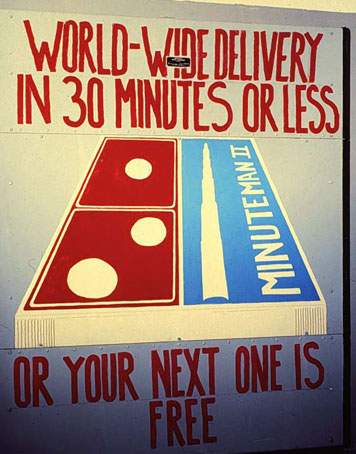
But Does It Come With Cheesey Bread?

From the blast door in a Minuteman II silo.

Wednesday, April 23, 2008

Alan Robock on Geoengineering and Nuclear Power

Alan Robock, one of the co-authors of those nuclear winter studies I just can't stop ranting about, on geoengineering:
Solving global warming is not a difficult technical problem. As Stephen Pacala and Robert Socolow detail with their popular wedge model, a combination of several specific actions can stabilize the world’s greenhouse gas emissions—although I disagree with their proposal to use nuclear power as one of their “wedges.” Instead, the crux of addressing global warming is political. The U.S. government gives multibillion- dollar subsidies to the coal, oil, gas, and nuclear industries, and gives little support to alternative energy sources like solar and wind power that could contribute to a solution. Similarly, the federal government is squashing attempts by states to mandate emissions reductions. If global warming is a political problem more than it is a technical problem, it follows that we don’t need geoengineering to solve it.

... how does that follow?

Global warming is a both a political problem and a technical problem. The way I see it, if Hansen's new study is right and we need to get atmospheric CO2 levels down to 350 ppm to avoid catastrophic climate change, we basically have two options:
1. Nuke China
2. Geoengineering

I don't know about you, but I think I'd rather take my chances with (2). Hopefully it can buy enough time to build a fission-based economy.

So what does Robock have against nuclear power?
In light of Edwin Karlow's letter supporting nuclear power (PHYSICS TODAY, February 2006, page 11) and the article "Stronger Future for Nuclear Power" in that same issue (page 19), I would like to remind readers of the many reasons why nuclear power is a bad idea.

Nuclear power is not economically viable. Karlow explains the subsidies that the nuclear power industry needed in the past and pleads for continued subsidies in the future. Contrary to the early promise that nuclear power would be so cheap we would not need electric meters, nuclear power is very expensive. The main reason is that it is so dangerous; expensive safeguards must be attempted.

The risk of a catastrophic accident persists. Nuclear power plants are built and run by humans, who make mistakes and who can be pressured into making decisions that put profit above safety. And the same government that took care of us after Hurricane Katrina will assume responsibility for us after a nuclear accident.

Nuclear power plants are possible terrorist targets. A dedicated attack against a nuclear plant could not be prevented, and the highly radioactive spent fuel is poorly contained in many plants and is particularly open to attack.

The waste disposal problem is not solvable in the near future. The politically chosen Yucca Mountain disposal site is nowhere near opening, precisely because of its geological problems, and because of local opposition. So spent fuel will continue to pile up around the country, producing increasingly dangerous sources of radioactive materials vulnerable to human error, accident, and attack.

Current nuclear plants are being operated unsafely. The Nuclear Regulatory Commission is lax in its supervision of those plants. The NRC does not have workable evacuation plans for many power plants, including the Indian Point plant just upwind of New York City and the oldest plant in the country, in Oyster Creek, New Jersey. Fire safety problems have not been addressed. Routine operation of nuclear plants results in planned and unplanned releases of radioactivity, and there is no safe level of radiation exposure. The procedures for extending the life of unsafe reactors do not allow meaningful public input.

The most important reason why nuclear power is a bad idea is that it results in nuclear weapons proliferation. A fuel-processing plant for a standard 1000-MW reactor could produce enough uranium for between 10 and 30 uranium weapons per year. Its waste reprocessing plant could produce enough plutonium for 30 plutonium weapons per year. It is no accident that Iran and Venezuela, nations awash in oil, are pursuing nuclear power. India and Pakistan received nuclear fuel and technical help from other countries to develop nuclear power, and took advantage of this opportunity to make nuclear weapons. And the material can find its way into the hands of terrorists. Even a small nuclear attack or a small war between newly nuclear states would be devastating to humanity. Having invented nuclear weapons, we physicists have a moral responsibility to do everything we can to lower the probability of their use.

I am a climatology professor doing research on global warming. In my opinion, we must reduce our greenhouse gas emissions to mitigate future negative consequences to the climate. But nuclear power is not the answer.

Wow, channeling Helen Caldicott there! It appears that Robock is an old-school anti-nuke of the kind who conflates nuclear weapons and nuclear power and somehow thinks they're both parts of the same immoral coin. But as someone who studies nuclear war for a living and nuclear power as a hobby, I have to say that Robock is poorly informed in both areas. The letter above is replete with the standard refrains of the anti-nuclear movement; pretty much all of them have been debunked repeatedly over the years, including by myself on this blog. I can appreciate his desire to prevent nuclear warfare; but his understanding of the psychology of nuclear states is, in my view, very much out of sync with reality. Not only do I think that he's adding to the climate crisis by dismissing the only viable tool we have for building a non-fossil fuel energy infrastructure, I think he's doing his own minor part to make nuclear war more likely by telling lesser nuclear powers that their arsenals offer more of a deterrent than they actually do. In sum, he's not a particularly good servant of either of his chosen causes.

Monday, April 21, 2008

The Future of Water-Cooled Graphite Reactors?

My poll about the merits of various reactor designs ended yesterday, and I was intrigued by the results. I had included a number of disreputable designs, including water-cooled and sodium-cooled graphite reactors. I suspect that whoever it was who voted for the RBMK was trying to be facetious, but it turns out that some people in Russia are actually still gunning for this type of reactor.

The MKER-1500 Proposal
Basically, the proposed MKER-1500 is a variant of the RBMK-1500 with the addition of significant safety improvements. The most noticeable of these is the inclusion of an actual containment building. Not only does this contain the massive RBMK reactor, but also a passive emergency cooling system (#2 on the above illustration.) The proposal argues that the design includes all modern safety features and is more economical with fuel than LWRs, while also offering the ability to produce radioisotopes for additional income. The authors suggested that this design be considered for the Leningrad Nuclear Power Plant. They don't seem to have won that argument, however, as Rosenergoatom appears set to start building four new VVER reactors there starting in 2013.

Friday, April 18, 2008

Атом-миру


Soviet "Atoms for Peace" propaganda poster. Found at plakaty.ru.

The Ebullient Optimist

Herman Kahn (1922-1983) was, and remains, one of the most misunderstood figures of the atomic age. But he was also one of the most influential, and any serious student of nuclear war needs to grapple with Kahn and his writings.

I'll admit it: I'm a big Kahn fan. Now, this isn't to say that I think Kahn was infallible. In fact, I think that his entire paradigm for thinking about nuclear war had severe limitations. But compared to those who came before him and most of those who came afterwards, his work was far more complete and consistent. At the same time, Kahn was an abysmal writer, which is a major reason why he is so little understood today. I think that On Thermonuclear War is much like Marx's Das Kapital- almost unreadable, often simply wrong, yet ingenious and vitally important both intellectually and historically.

In order to understand why On Thermonuclear War is such a landmark, one has to read the works that it supplanted- for instance, Bernard Brodie's The Absolute Weapon and Henry Kissinger's Thermonuclear Weapons and Foreign Policy. The Absolute Weapon, from 1946, was the original book on nuclear strategy. In it Brodie argued that the atomic bomb was the "absolute weapon" because once a nation possessed enough to reliably destroy the enemy's population centers there was no reason to acquire any more. Brodie failed to take into account the possibility of counterforce targeting, which was the centerpiece of Kahn's strategic thinking. Kissinger's book is a lot more interesting, and disturbing. Kissinger argued that the superpowers would soon begin utilizing tactical nuclear weapons in limited wars- essentially that they would agree not to respond to a few nuclear strikes in a place like Indochina with an all-out nuclear war. Both these works were later repudiated by their authors.

On Thermonuclear War is, first and foremost, an attack on the nuclear policies of the Eisenhower Administration. He charged that the then-current policy of "Massive Retaliation" was crude, destabilizing, unnecessarily brutal, and that if things continued on their then-current course the result would be "a catastrophe that would be much worse than it need be." Personally, I am convinced that, whatever the merits of Kahn's strategic thinking overall, he was right about this critical point. The misguided policies of the Eisenhower years appear to have led directly to the nuclear crises of 1961-2, which we now know came frighteningly close to devolving into the nightmare Kahn was trying to prevent.

Most readers of
On Thermonuclear War are distracted by Kahn's lengthy arguments that even a large thermonuclear exchange is survivable, given a great enough investment in civil defense. This is what first led me to Kahn- he was probably the single most important civil defense advocate in American history (although JFK has a serious claim to this title too.) It should be kept in mind that Kahn made this argument, in large part, because he was the world's greatest optimist. He genuinely believed that mankind could overcome even the greatest tribulations. Some of the details of Kahn's arguments about nuclear survival have aged well- for instance, the section on hereditary mutations looks pretty good in light of studies of atomic bomb survivors- but other parts of it have not. However, this does not undermine Kahn's basic strategic logic. It merely changes the shape of the concrete war plans that follow from them.

Kahn essentially argues that there are two kinds of nuclear wars: survivable and unsurvivable. He uses idealized thought experiments to argue that trying to deter enemies using preparations for the latter kind of war is a VERY BAD IDEA. The best explanation of this is in Kahn's discussion of doomsday machines, which he uses to illustrate this point. Although a doomsday machine offers a seemingly ideal "Type I" deterrence, the danger it poses is so great that it is ultimately far more trouble than it's worth.

According to Kahn, the ideal deterrent has six qualities:
1. Frightening
2. Inexorable
3. Persuasive
4. Cheap
5. Nonaccident prone
6. Controllable

Kahn concedes that the doomsday machine is a clear winner on the first five of these points. Indeed, he says that "it maximizes the probability that deterrence will work." But ultimately this is a fool's bargain, because "one must still examine the consequences of a failure. In this case, the failure kills too many people and kills them automatically."

Kahn transferred this logic from doomsday machines to more conventional strategies that resemble doomsday machines--in particular, to what would later become known as Mutually Assured Destruction. Kahn did NOT claim that this offered inferior deterrence to his proposed counterforce strategies. But he thought that it didn't offer ironclad deterrence--and given
the myriad real-world reasons deterrence could fail, the likely cost was far too high to merit the risk.

Therefore, deterrence needed to be based on the principle that nuclear wars should be fought to be won. The fact that some of the wars Kahn thought were winnable probably aren't does not actually invalidate this argument. It just changes the nature of the deterrent force. Arsenals of thousands of multimegaton hydrogen bombs are right out; instead, a more limited arsenal targeted primarily at enemy strategic forces makes the most sense. Indeed, something vaguely approximating this was adopted by the two superpowers, and the world has been considerably safer ever since. Because of this, I am of the opinion that Kahn's influence on human history has been overwhelmingly positive.

It's also important to remember that Kahn's 1960s strategic prescriptions were meant to be temporary. He thought that the bipolar arms race would be long over by the year 2000, but he feared that this would be the result of the development of a multipolar world with dozens of nuclear powers. He thought that preventing the use of nuclear weapons would be impossible under these circumstances. In any case, he did not intend for the deterrence strategies he championed to be made into a permanent fixture of international relations- they were intended to protect US interests for the next decade or two. The bizarre scenario that actually occurred- where the USSR collapsed, the United States achieved global near-hegemony, and yet the arms race and deterrence somehow failed to disappear- did not occur to him fifty years ago.

So what's wrong with Kahn? Well, he bought too much into contemporary pessimism about the possibility of negotiating meaningfully with the Soviets. (To his great credit, though, he emphasized that the USSR was a status-quo power. Back in the 1950s, that put him well ahead of much of the defense establishment.) He was also too dismissive of the positive roles culture plays in the function of nuclear deterrence. In Kahn's writing, culture is just a mental block against thinking seriously about nuclear warfare; but in the real world, it can keep decision-makers from escalating a conflict even when they logically should. Current scholarship on nuclear strategy is moving away from the realist explanations of behavior and motivation championed by Kahn to more nuanced explanations, and scholars like Graham Allison have made very convincing arguments that rational actor theory does not account for the behavior of the United States and Soviet Union in actual nuclear crises. This effectively upends Kahn's entire paradigm for understanding nuclear strategy, but it also arguably undermines deterrence theory in general.

If one wants to read Kahn, I recommend his 1962 book Thinking About the Unthinkable rather than On Thermonuclear War. Intended to be more readable, Kahn is also less extreme in this volume. I particularly like its chapter on alternative strategies for the Cold War, which has fourteen options ranging from surrender to preemption. For those who only know Kahn from the crude caricatures drawn by his critics, the conclusions of
Thinking About the Unthinkable will probably come as something of a shock- he endorses world government as the ultimate solution to (or perhaps outcome of) the geopolitical problems posed by nuclear weapons. His writing as a futurist is also worth looking into. A full-blown techno-optimist, Kahn retired from nuclear strategy in the 1970s to debunk the Club of Rome, Paul Ehrlich, and the other then-trendy eco-doomsters. Before he died in 1983 he lamented the crippling of nuclear power in the energy market. Indeed, at the time of his death he was better known as a futurist than as a strategist. But when either contemplating the possibility of nuclear annihilation or the potential of civilian nuclear energy, Kahn was forever the ebullient optimist.

Thursday, April 17, 2008

With "Friends" Like These...

Check out FoEAction's presidential campaign ads:


Does this mean I can be pro-nuclear by voting for ANY of the remaining candidates? SCORE!

If you like, you can also play with their interactive anti-nuclear video:

Well, that was solidly disingenuous. Hopefully these crude efforts are a sign of desperation on the part of the anti-nuclear movement.

1959 USAF Proposal to Use Nuclear Weapons in North Vietnam

One of the reasons that I decided to become a historian of the Cold War is because declassified documents are always providing new revelations about the conflict. For instance, I never would have guessed that the Air Force seriously proposed a nuclear strike on North Vietnam- in 1959!
Back in Washington, General White questioned whether any of the current military proposals would solve the Laotian dilemma. On September 8, the day the fact-finding committee for Laos was approved by the United Nations Security Council, he asked the Joint Chiefs of Staff for a green light to send a squadron of Strategic Air Command (SAC) B-47 jet bombers to Clark Air Base in the Philippines. White wanted to cripple the insurgents and their supply lines by attacking selected targets in North Vietnam, either with conventional or nuclear weapons. Although White's paper called for giving the North Vietnamese a preattack warning, the other chiefs tabled it, possibly due to the inclusion of nuclear weapons. Seven months later, the proposal was withdrawn. Still, the Air Force considered it a valid reflection of the long-standing USAF belief that Asian communists would be less likely to cause trouble if they knew U.S. counteraction would not be confined to Laos or conventional weapons.
This is from page 25 of a history prepared by the USAF in 1993, The War in Northern Laos, 1954-1973. The National Security Archive recently secured the release of this document through the Freedom of Information Act.

Wednesday, April 16, 2008

The Funniest Thing Ever Said About Herman Kahn

From Louis Rene Beres's 1985 review of Kahn's last book, Thinking About the Unthinkable in the 1980s:
Substituting metaphors and scenarios for carefully constructed theories, he spawned a generation of strategic mythmakers who now stand exultantly in the ruins of thought.
When I read this, I fell off my chair laughing because I had a vision of Kahn literally spawning a generation of strategic mythmakers.

I'll file this one under "criminal use of metaphor in a peer-reviewed journal."

Tuesday, April 15, 2008

James Hansen's Open Letter to Governor Gibbons of Nevada

I've blogged in the past about James Hansen's apparent support for nuclear power. Back in January, Hansen stated in a BAS editorial that:
Therefore, the only practical way to prevent carbon dioxide levels from exceeding 450 ppm is to phase out coal power except at plants where carbon emissions are captured and stored.

An outline of a practical way to do this can be readily defined: First, establish a moratorium in developed countries on construction of new coal power plants until effective carbon-capture-and-storage technology is viable; second, establish a similar subsequent moratorium in developing countries; and third, phase out existing coal plants over the next several decades and replace them with energy sources that don't emit carbon, such as wind, solar, and nuclear power, and coal plants with carbon capture and storage. Specifically, developed countries need to stop building coal power plants that don't capture and store carbon by 2012, developing countries need to halt such construction by 2022, and all existing coal power plants without carbon capture must be bulldozed by 2050.
Therefore, I was somewhat surprised when I read his new open letter to Governor Gibbons of Nevada, in which he states that:
Although the fossil fuel industry pedals misinformation, claiming that renewable energies can only be a niche contribution to energy needs, that contention defies common sense. As proof of the contrary, consider just one of the renewable energies, solar power. The technology for solar thermal power stations already exists, power stations can be built rapidly, and as the market for them increases their unit costs will fall steadily, as the cost of coal power continues to rise. There is enough solar energy in a small fraction of our desert Southwest to provide all of the electrical needs of the United States. Nevada has the potential to be a leader in this field, providing power for itself and for distant locations as a low-loss grid is developed. Leadership would provide great economic benefit to Nevada and provide a large number of high-pay jobs and new businesses.
I'm really rather disappointed to learn that Hansen has drunk Ausra's Kool-Aid (why don't people realize that they haven't built a real plant yet and their estimated costs and capabilities are a marketing pitch?), as well as that he seems to have bought into the silly "solar grand plan" published in Scientific American a few months ago. However great an authority Hansen may be in the field of climatology, it seems he has a lot to learn when it comes to energy technology. The piece doesn't mention nuclear power at all, unlike the January editorial; I'm hoping that this is because of the Yucca Mountain boogeyman, but maybe it represents a shift in Hansen's position. That would be too bad, since he was pretty reasonable before but now seems to have bought into wishful thinking that, in practice, is preserving the energy status quo as much as the efforts of the fossil fuel industry.

Saturday, April 12, 2008

New Radioprotective Drug Actually Works

This week in Science:
In summary, CBLB502 reduces radiation toxicity without diminishing the therapeutic antitumor effect of radiation and without promoting radiation-induced carcinogenicity. These properties of a TLR5 agonist acting as an NF-{kappa}B–inducing agent provide further support for our concept of pharmacological imitation of tumor-specific antiapoptotic mechanisms as an approach to radioprotection. This approach was first validated by our demonstration that a chemical inhibitor of the proapoptotic p53 pathway safeguarded mice from lethal acute radiation syndrome. However, we subsequently found that wild-type p53 plays an unexpected role as a survival factor in GI cells exposed to high doses of {gamma}-irradiation, limiting the usefulness of p53 inhibitors to protection against HP, but not GI, acute radiation syndrome. This problem has been resolved by our identification of CBLB502 as a TLR5 agonist that can protect against both major acute radiation syndromes. Our results suggest that TLR5 agonists may be valuable as both adjuvants for cancer radiotherapy and protectants or mitigators for radiation emergencies.

This is pretty spectacular. Animal studies showed a marked increase in survival rates at very high radiation doses- 13 Gy for the mice and 6.5 Gy for the Rhesus monkeys. The most obvious use of the drug is to to protect cancer patients from the effects of radiotherapy- amazingly, it doesn't appear to impact the radiosensitivity of tumors- but it also has potential emergency management applications.

Effective radioprotective drugs were one of the holy grails of civil defense researchers back in the 1950s. The hope was that these drugs could make fallout protection more practical by reducing shelter requirements. Optimists dreamed of drugs that would make fallout shelters unnecessary. High hopes were soon dashed, however. The few radioprotective agents discovered were unable to provide protection against acute radiation poisoning- the circumstance that interested civil defense. Soviet civil defense retained more interest in the idea, and issued an "individual first aid kit" containing drugs for use by individuals in a major war. It contained antibiotics, anti-vomiting medication, nerve gas antidote pills (!), several "anti-radiation drugs" (I have yet to identify exactly what), and a syringe full of morphine.

If CBLB502 can be made into a practical emergency management tool, it could make mass radiation protection much more practical. In particular, it could reduce the immediate needs for sheltering and evacuation following a radiological dispersal event enormously. It's not an absolute panacea- due to the way the drug works it is probably unsafe for children and pregnant women. But it could turn the unsolvable nightmare of protecting the people of a densely populated area from radiation poisoning into a manageable scenario. That's pretty impressive.

Wednesday, April 09, 2008

The New Toon et Al. Study on Regional Nuclear Conflict and Ozone Depletion

From the new study published Monday in The Proceedings of the national Academy of Sciences:
We use a chemistry-climate model and new estimates of smoke produced by fires in contemporary cities to calculate the impact on stratospheric ozone of a regional nuclear war between developing nuclear states involving 100 Hiroshima-size bombs exploded in cities in the northern subtropics. We find column ozone losses in excess of 20% globally, 25–45% at midlatitudes, and 50–70% at northern high latitudes persisting for 5 years, with substantial losses continuing for 5 additional years. Column ozone amounts remain near or <220> even after three years, constituting an extratropical "ozone hole." The resulting increases in UV radiation could impact the biota significantly, including serious consequences for human health.
What's the catch? The authors are using the flawed 2007 Toon et al. study as the source of their figure for soot injection into the upper atmosphere. The authors assume that ALL targeted cities will produce mass fires with efficient pyroconvective pumping, that these fires will consume basically all available flammable material in the target cities, and that rainout will only remove 20% of the soot before it reaches the upper atmosphere. These are not valid assumptions, and real-world experience with atmospheric nuclear weapons detonations does not bear them out.

There is a fairly well-developed literature on fire effects from nuclear explosions- in particular, the work of Harold S. Brode, but also the work of civil defense researchers in both the United States and Soviet Union- that the authors of this study chose to conveniently ignore. There was actually considerable controversy regarding the extent of fire effects decades ago, which is described in a 2006 book by Lynn Eden, Whole World on Fire. Brode took the pessimistic view, arguing that mass fires would occur in most circumstances following nuclear explosions of yields in excess of a few hundred kilotons. Because modern strategic nuclear warheads all exceed this threshold, he postulated that fire effects would be far greater than had been predicted earlier. The civil defense researchers, meanwhile, used real-world experience to attempt to create a set of heuristics for understanding fire effects. They studied WWII bombing experience and were able to test real buildings in atmospheric nuclear tests. This memorable 1954 film is an example of their hands-on techniques:

The civil defense researchers concluded that firestorms were an unpredictable effect, responding strongly to the contingencies of weather, topography, fuel loading, and other factors. I'm personally a bit more sympathetic to their views than I am to Brode's, but Brode was no slouch- he is one of the foremost experts on nuclear weapons effects that the world has ever produced. But even Brode's relatively extreme views are incompatible with the bizarre assumptions made in the 2007 Toon et al. study, and consequently the many studies that now use its conclusions to model the effects of regional nuclear conflict. The extremely low 20% rainout value is particularly problematic- the authors have no real justification for it other than "because we used it in 1990, and it arguably happens this way in some forest fires." I have a hard time imagining that observers in the USSBS could possibly have missed noticing that the firestorms produced by Allied bombing had injected MOST OF THE MATERIAL IN THE TARGET CITIES into the upper atmosphere- which is the assumption that the study makes. (Examine section 6.1 to understand what I mean.) However, that doesn't keep them from telling reporters that their rainout value is one of their findings, rather than one of their assumptions:
"All the new models came up with the same results," Toon said, "and they gave us two surprises: One was the huge quantity of smoke that would be produced from even the limited nuclear war in our scenario, and the other was the conclusion that the smoke would remain dense above the stratosphere for as long as five years."
Indeed, neither Hiroshima or Nagasaki appears to fit the assumptions made in the study- rainout at Hiroshima seems to have been pretty pronounced (the famous black rain), and Nagasaki failed to develop into a full-blown firestorm due to the local topography. In any case, rainout after a nuclear explosion is NOT the same as rainout resulting from a forest fire, as is attested by this 1988 study and this 1979 study of rainout following the atomic bombings in Japan. In short, Toon et al. really didn't do their research- at all.

Tuesday, April 08, 2008

Russian Civil Defense and Chernobyl

From an October 2007 article on Volgograd.ru:
В наше время, когда усложняются технологические процессы, когда в производствах применяется всё больше сильнодействующих ядовитых веществ, легковоспламеняющихся жидкостей и радиоактивных веществ, когда увеличивается количество катастроф и стихийных бедствий, значительно возросла социально-экономическая значимость Гражданской обороны.

In our time, when technological processes are becoming more complicated, when ever more powerful poisonous, inflammable, and radioactive materials are used in production, when the number of catastrophes and disasters is increasing, the socio-economic significance of Civil Defense has grown significantly.
After the Chernobyl accident, Western critics of civil defense argued that the ineptitude of the initial government response proved the worthlessness of the Soviet civil defense system. But it has become increasingly apparent that this was not the lesson drawn from Chernobyl by the current Russian civil defense service, the Ministry of Emergency Situations (MChS). In their view, Chernobyl was not a pathetic failure, but rather evidence of their own heroism and proof that civil defense is worthwhile:

В первых рядах ликвидаторов последствий Чернобыльской АЭС были сотрудники Гражданской обороны и среди них наши коллеги: полковник Кравцов В.Е., полковник запаса Семёнов А.Г., и другие.

Уроки Чернобыля и других чрезвычайных ситуаций указали на необходимость проведения целого комплекса мероприятий по приведению гражданской обороны в соответствие с социально — экономическими преобразованиями, проводимыми в стране. Гражданская оборона становится самостоятельным ведомством в структуре исполнительной власти. Государственный комитет по ЧС получает статус Министерства Российской Федерации по делам гражданской обороны, чрезвычайным ситуациям и ликвидации последствий стихийных бедствий.

In the first ranks of the liquidators of the Chenobyl AES were civil defense workers and among those our colleagues: Colonel V.E. Kravtsov, reserve Colonel A.G. Semeinov, and others.

The lessons of Chernobyl and other emergency situations demonstrated the necessity of constructing a complete complex of measures for mobilizing civil defense in accordance with the socio-economic transformations taking place in the country. Civil defense constitutes an independent entity within the the structure of executive power. The State Committee on Emergency Situations holds the status as Ministry of the Russian Federation on Affairs of Civil Defense, Emergency Situations, and the Liquidation of the Consequences of Major Disasters.

It'd be interesting to know how many Russians buy into this message; my experience talking to them is too sketchy to get a real feel for what the prevailing sentiment is.

Sunday, April 06, 2008

Radioactive Man in a Radioactive World


Radiation and Life episode one, 1992. This film, made immediately after the fall of the Soviet Union by the Russian Institute of Radiation Hygiene, was intended to assuage popular fears of radiation on the part of Russians in the aftermath of Chernobyl.

Saturday, April 05, 2008

Will Gore "Shut the Nuke Power Loophole?"

Harvey Wasserman's latest:
Today Al Gore is unveiling a massive campaign to fight climate chaos.

But the hugely funded atomic power industry has jumped on global warming with the Big Lie that its failed reactors can somehow help. It's a sorry replay of the 1950s promise that atomic power would be "too cheap to meter."

Just before the 2000 election, as senior advisor to the Nuclear Information & Resource Service, I wrote then-Vice President Gore asking that he help delete from the Kyoto Accords any reference to nukes as a possible solution to global warming. On November 3, 2000 (the letter is posted at the www.nirs.org web site) Gore wrote back:

"Thank you for your recent inquiry regarding nuclear energy and the Kyoto Protocol. Let me restate for you my long held policy with regard to nuclear energy. I do not support any increased reliance on nuclear energy. Moreover, I have disagreed with those who would classify nuclear energy as clean or renewable. In fact, you will note that the electricity restructuring legislation proposed by the [Clinton] Administration specifically excluded both nuclear and large scale hydro-energy, and instead promoted increased investment in energy efficiency and renewable energy. It is my view that climate change policies should do the same."

Nukes were soon deleted from the Kyoto Accords as a "solution" to global warming.
Has anything changed in the last eight years?

Let's see what Al Gore himself has to say about it:
Toward the end of the meeting at Kleiner's offices with Ausra, the solar thermal company, one of the executives starts to boast that the plants Ausra is building will thrash nuclear, geothermal, clean coal, and photovoltaic solar solutions. Gore cuts in, a mildly alarmed look on his face. "You know, all of these technologies are going to play a role," he says. "I hate to see you assassinate the competition as a key messaging point."
If that's any indication, Wasserman isn't likely to get his wish. On the other hand, I'm doubtful that Gore will really come out for nuclear power. Which is a shame, since it's becoming more apparent every day that when it comes to global warming, anti-nuclear fundamentalists are part of the problem, not the solution.

Besides, we have our own champion- Sir David King. His scientific credentials are impeccable, and he's made a difference where it really counts. The last few years have seen a real sea change in the fortunes of nuclear power. While I hope that Gore will see the light and join King in endorsing new nuclear builds, I don't think that Al Gore can single-handedly stop the nuclear renaissance, even in the United States.

Wednesday, April 02, 2008

Possibly the Strangest Soviet Book About Nuclear Energy


The Atom and the Postage Stamp, published in Moscow by the Atomizdat publishing house in 1978. I would never have guessed that this book existed, but it's for sale on the Russian equivalent of eBay. I suspect that it's about the many atomic-energy themed stamps issued by the Soviet postal service.

Tuesday, April 01, 2008

Selling the MSBR

Recently on his excellent blog about nuclear goings-on in Oak Ridge, Frank Munger posted a link to "Risky Appropriations: Gambling U.S. Energy Policy on the Global Nuclear Energy Partnership," a report critical of GNEP. Written by Friends of the Earth USA, Government Accountability Project, Institute for Policy Studies and the Southern Alliance for Clean Energy, it argues that
"The administration’s rush to develop and deploy GNEP is unnecessary and imprudent. Instead of committing to a program that may ultimately cost more than $700 billion, the administration should take a more reasoned approach and study whether there are less costly and more proliferation-resistant alternatives than a dramatic expansion of the nuclear industry for achieving the goalsof reducing reliance on fossil fuels and greenhouse gas emissions and finding a viable long-term storage option for the existing stockpiles of spent reactor fuel wastes."
Now, I know that the authors of the report have a well-established bias against nuclear power. I also think that they're throwing the baby out with the bathwater- international cooperation on advanced fuel cycle research is a really good idea and should be encouraged. But they have a real point here, as the current GNEP proposals leave a lot to be desired.

In my view, the Achilles' heel of GNEP in its current form is its dependence on fast-neutron Advanced Burner Reactors (ABRs) to manage spent fuel from the current LWR fuel cycle. Currently, the ABR is conceived of as a sodium-cooled design. The history of sodium-cooled reactors has been disappointing, to say the least. The spectacular neutron economy they can theoretically achieve attracted many adherents. But generations of nuclear engineers have never been able to make these designs safe, reliable, and affordable simultaneously. The Russians have had the most success with the BN-600, but even it has been plagued by problems in its 28 years of operation.

There are also serious problems inherent in the projected GNEP fuel cycle- that it would use UREX+ reprocessing technology. This would require constant transport of fuel assemblies to and from LWRs, ABRs, and reprocessing plants. Honestly, I think that many of the problems faced by GNEP are probably inescapable in a system using solid-fuel reactors.

Fortunately, we have a technological alternative to the flawed vision of the current GNEP proposal. Molten-salt breeder reactors are, in my opinion, the best technology we have for facing the many challenges of the 21st century. Real-world experience with this reactor, while much less extensive than that with LMFBRs, was much more promising. The ability to use extremely common Th-232 as fuel eliminates the problems associated with the inefficiency of the current LWR fuel cycle. MSBRs can be safe, proliferation-resistant, and affordable. They can be built quickly on assembly lines from modular components. Most importantly, the MSBR is probably the only technology with the potential to ameliorate the climate crisis and provide the energy needed for third world economic development at the same time.

Unfortunately, it seems that hardly anyone outside of a relatively limited circle of nuclear enthusiasts knows about the spectacular potential of molten-salt reactors. This has to change, and soon. We need to get the message out- to the government, to the scientific community, and to the people at large.

On the first note, we need to find advocates for the technology in all areas of the government. Obviously, it would be ideal if the next president was an MSBR advocate, but it will be necessary in any case to have support in Congress- particularly in critical committees. Another vital area of support we need is from the leadership of the national laboratories. Infighting between them could cripple a major research program. My hope is that the less-than-optimal program GNEP now represents will be replaced by an aggressive research program into liquid-fuel reactor designs. In particular, the ABTR could be replaced by a prototype MSR along the lines of what Kirk Sorensen has been advocating.

If growing up in Oak Ridge taught me anything, it's that even brilliant scientists who work in a nuclear weapons laboratory aren't necessarily nuclear power experts. Most members of the scientific community know little about the differences between various reactor designs, fuel cycles, and so on. It is very important that figures such as James Hansen, who has stated publicly that "advanced nuclear power" is part of the solution to climate change, understand that the MSBR is the technology best suited to this role. I'm not sure what the best way to go about this is. Perhaps an article in a very prominent journal (the kind that's read outside of a single sub-discipline, like Nature) about the advantages of the MSBR for mitigating climate change? It could propose a concrete scenario for reactor construction and tabulate the overall environmental externalities for such an endeavor. Ideally, it would be as complete as reasonably possible, including cost estimates for all stages of the construction, operation, and decommissioning of the plants.

Finally, ordinary people need to learn about the MSBR. I believe that the popular appeal of the MSBR lies in its superior safety and waste management characteristics, as well as its potential to make the United States less dependent on foreign energy imports. The mind-boggling energy content of the Lehmi Pass thorium deposit could make an instructive talking point.

It would also be a good idea to prepare now for the inevitable criticism of the professional antinuclear crowd. I suspect that once they perceive the MSBR as a threat, they'll latch onto the lengthy and troubled decommissioning of the Molten Salt Reactor Experiment at ORNL as the easiest way to attack the technology. Advocates of molten-salt reactors need to have ready answers to questions about this issue. Perhaps the reactors could be designed to be broken down into modular components and then transported to some kind of dedicated decommissioning facility. I suppose it depends on many factors- decommissioning an MSBR constructed from carbon-carbon composites could be very different from decommissioning the MSRE has been.

In any case, tell your friends about the MSBR!