I know that it's been quite awhile since I last posted. It's not because I've given up my nuclear studies, but rather because I've been preoccupied writing my dissertation and several articles. As is seemingly the case with everyone in academia these days, I'm always striving for a higher impact factor, which I need in order to build up my CV for when I start applying for jobs. My first article came out a few months ago, and I have two more appearing later this year, including my piece on the history of the Soviet civil defense bomb shelter program which will be featured in the Journal of Cold War Studies later this summer.
I know that I had some readers who were hoping for some Chernobyl goodies, and may have wondered why I never posted any more about my research findings from my time in Ukraine last year. The reason is that I've been composing a scholarly article on the topic, which I've now submitted for peer-review. My findings challenge some longstanding beliefs about the Chernobyl accident, so I'm hoping the piece will be an attention-getter.
In other news, in July I'm going to Kazakhstan to tour the old Soviet nuclear testing site at Semipalatinsk, and (if I'm really lucky) the decommissioned BN-350 sodium-cooled fast reactor/desalination plant.
Friday, May 04, 2012

Friday, May 27, 2011
Kiev
Yet again, I must apologize for neglecting this blog. I've been quite preoccupied with my research. I finished up my time in Washington a few weeks ago and have now moved to Kiev for the summer to study in the archives here. I've tracked down some very interesting documents about Chernobyl that I will be using as part of my dissertation. I really wish I could photograph these things and post them on the blog, but unfortunately the archive they are in doesn't allow photography. For instance, the include reports made for the Communist Party about the radiation level in Kiev and other Ukrainian cities after the accident.
I've also been hesitant to comment on the still-developing situation in Japan, in large measure because detailed, accurate information seems so hard to come by. Until the accident sequence is nailed down, trying to draw concrete "lessons" from the events there will be a fool's game. At the moment TEPCO is claiming that the earthquake was not the cause of the failures at Fukushima Daiichi units 1-3, and that the tsunami alone resulted in the deplorable outcome there. This is hotly contested by some, however, who claim that the emergency core cooling system in unit 1 failed prior to the tsunami. Even if this were the case, the availability of auxiliary power in the absence of the tsunami would presumably have allowed the operation of the standby gas treatment system and prevented the hydrogen explosion as well as captured most of the volatile radioisotopes, so the end result would probably have been far less dire.
The great mystery to me is what happened in unit 4, which experienced damage to the refueling floor blow-out panels. Back in March it appeared that somehow the water level in the spent fuel storage pool in unit 4 had grown so low as to expose the fuel, resulting in the zirconium-steam reaction and the creation of large amounts of hydrogen. But TEPCO images of the unit 4 pool show that the fuel is basically intact. It's supposedly implausible that radiolytic alone hydrogen production could have had the observed result; one possibility is that hydrogen from unit 3, which apparently shared a ventilation stack with unit 4, backed up into unit 4. Presumably what actually happened will become clear as efforts to stabilize the plants continue.
In July I'm planning on a return trip to Chernobyl, which should hopefully include some sites I missed out on last time. I'm also trying to arrange a visit to an operating VVER plant here in Ukraine, but no definite word on that yet. Hopefully I'll have interesting things to say about it.
I've also been hesitant to comment on the still-developing situation in Japan, in large measure because detailed, accurate information seems so hard to come by. Until the accident sequence is nailed down, trying to draw concrete "lessons" from the events there will be a fool's game. At the moment TEPCO is claiming that the earthquake was not the cause of the failures at Fukushima Daiichi units 1-3, and that the tsunami alone resulted in the deplorable outcome there. This is hotly contested by some, however, who claim that the emergency core cooling system in unit 1 failed prior to the tsunami. Even if this were the case, the availability of auxiliary power in the absence of the tsunami would presumably have allowed the operation of the standby gas treatment system and prevented the hydrogen explosion as well as captured most of the volatile radioisotopes, so the end result would probably have been far less dire.
The great mystery to me is what happened in unit 4, which experienced damage to the refueling floor blow-out panels. Back in March it appeared that somehow the water level in the spent fuel storage pool in unit 4 had grown so low as to expose the fuel, resulting in the zirconium-steam reaction and the creation of large amounts of hydrogen. But TEPCO images of the unit 4 pool show that the fuel is basically intact. It's supposedly implausible that radiolytic alone hydrogen production could have had the observed result; one possibility is that hydrogen from unit 3, which apparently shared a ventilation stack with unit 4, backed up into unit 4. Presumably what actually happened will become clear as efforts to stabilize the plants continue.
In July I'm planning on a return trip to Chernobyl, which should hopefully include some sites I missed out on last time. I'm also trying to arrange a visit to an operating VVER plant here in Ukraine, but no definite word on that yet. Hopefully I'll have interesting things to say about it.
Saturday, March 12, 2011
Fukushima Daiichi: Learning From Chernobyl
I must apologize for my long respite from blogging. I've felt compelled to concentrate on my dissertation and several academic articles I've been working on. This effort has produced results--my article about Soviet civil defense has been accepted for publication, and I was interviewed for a TV documentary. As one might imagine, however, today I was distracted by the events in Japan.
My dissertation research is about nuclear disaster. I actually do basically sit around all day long reading about it, thinking about it, and writing about it. I have dreams about it. So of course, recent events have distracted me from getting my work done.
First and foremost, we should keep in mind the enormous human tragedy that has occurred due to this earthquake. The death toll keeps rising, and I'm sure there will be no definitive estimate anytime soon. But in the American media, at least, concerns about the nuclear plant problems have completely overshadowed the immense suffering millions of Japanese are facing right now. This is a national embarrassment. At the same time, I must admit I'm absolutely guilty of it myself.
Commentators began making comparisons to Chernobyl even before there was any real indication of problems at the plants in Japan. Such comparisons have grown increasingly common as the past two days have progressed. Usually, however, the focus is on the plants themselves and potential of actual radiation releases, and not on the emergency response to the reactor problems. On this score, I believe that the Japanese deserve our praise. Clearly, they have learned the lessons of Chernobyl and are applying them in practice.
By taking the steps of evacuating the region around the damaged plants and distributing potassium iodine tablets, the authorities have likely avoided the most dire human effects of any possible radiation release. Although I cannot find any sources at the moment stating if the evacuation effort is yet complete, once all residents have left the area the human effects of even a very large radiation release should be reduced to negligible levels. This is in contrast to Chernobyl, where authorities chose to pretend the situation was not serious, and left the residents of Pripiat in place well after the explosion.
Similarly, the Japanese government has decided to assume the worst in managing the stricken reactors at Chief Cabinet Secretary Yukio Edano has stated that even though it has not been confirmed, officials are presuming partial meltdowns at
My dissertation research is about nuclear disaster. I actually do basically sit around all day long reading about it, thinking about it, and writing about it. I have dreams about it. So of course, recent events have distracted me from getting my work done.
First and foremost, we should keep in mind the enormous human tragedy that has occurred due to this earthquake. The death toll keeps rising, and I'm sure there will be no definitive estimate anytime soon. But in the American media, at least, concerns about the nuclear plant problems have completely overshadowed the immense suffering millions of Japanese are facing right now. This is a national embarrassment. At the same time, I must admit I'm absolutely guilty of it myself.
Commentators began making comparisons to Chernobyl even before there was any real indication of problems at the plants in Japan. Such comparisons have grown increasingly common as the past two days have progressed. Usually, however, the focus is on the plants themselves and potential of actual radiation releases, and not on the emergency response to the reactor problems. On this score, I believe that the Japanese deserve our praise. Clearly, they have learned the lessons of Chernobyl and are applying them in practice.
By taking the steps of evacuating the region around the damaged plants and distributing potassium iodine tablets, the authorities have likely avoided the most dire human effects of any possible radiation release. Although I cannot find any sources at the moment stating if the evacuation effort is yet complete, once all residents have left the area the human effects of even a very large radiation release should be reduced to negligible levels. This is in contrast to Chernobyl, where authorities chose to pretend the situation was not serious, and left the residents of Pripiat in place well after the explosion.
Similarly, the Japanese government has decided to assume the worst in managing the stricken reactors at Chief Cabinet Secretary Yukio Edano has stated that even though it has not been confirmed, officials are presuming partial meltdowns at
Saturday, October 23, 2010
Wait, FEMA Got to Edit the Script of The Day After?
I apologize that I haven't been posting much lately, as I've been very busy researching the American aspect of my dissertation. I'm currently living in College Park, Maryland and working through civil defense records in the National Archives annex here. It's fairly exciting as a great deal of this material is unexamined--I'm the first person to look at it since it was packed away decades ago. The documents I've looked at date from the Truman to the Reagan administrations.
So far the material from the 40s and 50s hasn't been all that ground-breaking; a lot of it is neat but it hasn't really challenged my longstanding thesis about the Federal Civil Defense Administration and its many problems. The stuff from the 80s is quite another matter. Only a very limited amount of documents from FEMA are available in the National Archives, and half of the boxes I've ordered so far were withheld and I was told that I would need to file a FOIA request to look at them. Those I've been able to access so far, however, have forced me to seriously reconsider some of my assumptions about civil defense in the Reagan era.

FEMA Public Affairs Memorandum About The Day After, August 13, 1982
One of the big surprises so far was this August 13, 1982 memorandum from FEMA Public Affairs chief Jim Holton about The Day After. One would hardly suspect that this 1983 ABC television movie had been edited at the request of FEMA to be more flattering to civil defense, but it was. As Holton noted,
What precisely were these changes? Unfortunately, I do not have my DVD of the film here in College Park, so I am forced to rely on memory. The problem is complicated by the fact that The Day After, as originally filmed, was intended to to be a four-hour film aired in two parts, and a great deal of it ended up on the cutting room floor. As a result I'm not sure how much FEMA impacted the film as aired, but its impact on the shooting script appears undeniable. From the the revision of the script in FEMA's records, I suspect the changes were that skeptical references to Crisis Relocation Planning--the evacuation scheme being pushed by FEMA in the early 1980s--were toned down, as was the post-attack scene where an agronomist is attempting to convince skeptical farmers to scrape off their topsoil and one of them makes an angry outburst.
FEMA got to edit the script of The Day After? Who would've thought?
So far the material from the 40s and 50s hasn't been all that ground-breaking; a lot of it is neat but it hasn't really challenged my longstanding thesis about the Federal Civil Defense Administration and its many problems. The stuff from the 80s is quite another matter. Only a very limited amount of documents from FEMA are available in the National Archives, and half of the boxes I've ordered so far were withheld and I was told that I would need to file a FOIA request to look at them. Those I've been able to access so far, however, have forced me to seriously reconsider some of my assumptions about civil defense in the Reagan era.

FEMA Public Affairs Memorandum About The Day After, August 13, 1982
The attached script for the forthcoming ABC-TV prime time movie was given to us last week and, as you'll notice on the cover sheet, it is the latest in a series of revisions. This version reflects a number of changes which DoD insisted on before agreeing to support in the making of the film, support such as the use of National Guard troops, certain unclassified facilities, military vehicles and aircraft, etc. Unfortunately, our only contribution to the production is some dosimeters, the withdrawal of which would not bother ABC films.
It should be noted, however, that the revised script has been changed to reflect suggestions we made to the producers several months ago and which had not been included in the draft before this one. DoD, in using their clout to get the changes they wanted also leaned on ABC to make the FEMA-requested amendments, nearly all of which they responded to. They are on pages 30, 31, 176, 177, and 178.
What precisely were these changes? Unfortunately, I do not have my DVD of the film here in College Park, so I am forced to rely on memory. The problem is complicated by the fact that The Day After, as originally filmed, was intended to to be a four-hour film aired in two parts, and a great deal of it ended up on the cutting room floor. As a result I'm not sure how much FEMA impacted the film as aired, but its impact on the shooting script appears undeniable. From the the revision of the script in FEMA's records, I suspect the changes were that skeptical references to Crisis Relocation Planning--the evacuation scheme being pushed by FEMA in the early 1980s--were toned down, as was the post-attack scene where an agronomist is attempting to convince skeptical farmers to scrape off their topsoil and one of them makes an angry outburst.
FEMA got to edit the script of The Day After? Who would've thought?
Thursday, October 21, 2010
Basics of Soviet Civil Defense-1980
1980 Soviet civil defense propaganda film "Основы Гражданской обороны"--"Civil Defense Basics."
Wednesday, August 04, 2010
RBMK Control Room

Control room of Chernobyl NPP Unit 1

These gauges indicate position of control rods in the active zone. Black boxes are neutron flux indicators.
 These are the controls for some of the many control rods in the RBMK. You hold down the appropriate button and use the joystick on the left to move them in or out of the active zone.
Six emergency shutdown switches. "АЗ5" switch (top row, center) initiated rapid emergency shutdown.
Tuesday, August 03, 2010
Can You Spot the Math Error?
Trawling around the interwebs, I encountered the following critique of vertical farm concepts at TreeHugger:
Fortunately, the included "calculations" reveal the source of the problem:
To be fair I've seen equivalent mathematical goofs from the proponents of these fanciful vertical farm concepts. A lot of people aren't dotting their Is and crossing their Ts, so to speak. I actually like the concept, but it needs ample cheap energy to work--basically, it would have to be coupled with nuclear reactors. I have no problem with that myself. But I don't think it will be a near-term development in any case.
This led us to wonder, "What would be the consequences of a vertical-farming effort large enough to allow us to remove from the landscape, say, the United States' 53 million acres of wheat?"...Our calculations, based on the efficiency of converting sunlight to plant matter, show that just to meet a year's U.S. wheat production with vertical farming would, for lighting alone, require eight times as much electricity as all U.S. utilities generate in an entire year [see calculations here].This evoked a raised eyebrow from me, given the widespread claim that American agriculture uses vastly more fossil fuel energy than it delivers in terms of total food calories. Something doesn't add up here--clearly, someone is very, very wrong about the amount of energy embodied in our foodstuffs.
Fortunately, the included "calculations" reveal the source of the problem:
The following is a very rough estimate of the amount of power needed just for lighting vertical farms to grow the U.S. wheat crop. Note this is under ideal conditions for nutrients, temperature, and other productivity factors. Under excellent conditions, wheat has radiation use efficiency of 2.8 grams of biomass produced per 106 joule of photosynthetically active radiation (PAR). So to produce one metric ton (106 g) of wheat biomass requires [106 g / (2.8 g/106 J)] = 3.6 × 10¹¹ joules of PAR over a season under ideal conditions.Oops. >BANGS HEAD ON DESK< (3.6 x 10¹¹ joules is the amount of energy in 10,526 liters of gasoline. That's a lot of energy for just one metric ton of wheat... )
To be fair I've seen equivalent mathematical goofs from the proponents of these fanciful vertical farm concepts. A lot of people aren't dotting their Is and crossing their Ts, so to speak. I actually like the concept, but it needs ample cheap energy to work--basically, it would have to be coupled with nuclear reactors. I have no problem with that myself. But I don't think it will be a near-term development in any case.
Saturday, June 19, 2010
Chernobyl Exclusion Zone
In the post I wrote before I left for Ukraine, I wrote:
Now that I'm back in Moscow and have had some time to digest, I think I can issue some kind of statement on these questions.
Was Chernobyl an unprecedented ecological disaster zone? Definitely not. The radiation levels in the vast majority of the exclusion zone are now quite low--so much so, that our guide, Maxim, told us that he expects that the 30km zone will be opened up within another few years and that only the 10km zone will remain. There are, however, some significant hot spots in the 10km zone. The hottest place we ever got to in Pripiat was .25 rem/hr; but that was highly unusual. I think the usual level is a millirem/hr or less. Even in places near the sarcophagus it's many orders of magnitude lower than that. For instance, at the place I'm standing in this picture the ambient exposure is 2 millirem/hr:

However, according to a map we saw in the plant, the roof and part of the grounds on one side of the sarcophagus have exposure levels of up to 1.5 rem/hr. While that would take quite awhile to kill you outright, it's a serious workplace hazard and must make the life of the Novarka employees who are building the new sarcophagus very interesting...
Despite these isolated locations, the overall radiation hazard in the vast majority of the zone is nothing to get worked up about, in my view.
Was the zone a latter-day Eden enabled by the lack of human inhabitation? This I don't feel I can answer definitively. During my time in the zone I spent most of my time either in Pripiat or at the plant itself. Maxim told us that they had started shooting the wild boars once they began infringing on Chernobyl too much (the town the plant was named after and where the hotel is). Flies, midges, and mosquitoes were certainly in evidence; I'd have to spend time in other parts of the zone to determine if the wildlife lives up to the stories about it. Pripiat sees a lot of traffic, considering; there is a lost of post-1986 litter lying around, and at least several busloads of people come through every day.
Was it the world's biggest time capsule? Certainly less so than I would've liked. Thieves and scavengers (and I imagine simple vandals) have stolen or wrecked more or less everything that was worth taking. For instance, they stole the refrigerators from the top floor of a 16-story apartment block we visited--WITHOUT power to operate the elevators. It's astonishing how picked-over the apartments were, especially compared to places like the hospital and schools that see much more tourist traffic.
But was the zone still a toybox of wonderful Soviet things? Certainly. It was fascinating to see the remnants of aspects of Soviet life that I had read about but never seen--bottles and jars collected for reuse, basement vegetable cellars in the kindergarten, communal kitchens, and especially bomb shelters.

Wait--they had Diet Pepsi in the Soviet Union?!!? From the Pripiat Bus Garage
Will it be an unparalleled ecological disaster zone? A latter-day Eden enabled by the lack of human inhabitation? The world's biggest time capsule? A toybox of wonderful Soviet things?
Now that I'm back in Moscow and have had some time to digest, I think I can issue some kind of statement on these questions.
Was Chernobyl an unprecedented ecological disaster zone? Definitely not. The radiation levels in the vast majority of the exclusion zone are now quite low--so much so, that our guide, Maxim, told us that he expects that the 30km zone will be opened up within another few years and that only the 10km zone will remain. There are, however, some significant hot spots in the 10km zone. The hottest place we ever got to in Pripiat was .25 rem/hr; but that was highly unusual. I think the usual level is a millirem/hr or less. Even in places near the sarcophagus it's many orders of magnitude lower than that. For instance, at the place I'm standing in this picture the ambient exposure is 2 millirem/hr:

However, according to a map we saw in the plant, the roof and part of the grounds on one side of the sarcophagus have exposure levels of up to 1.5 rem/hr. While that would take quite awhile to kill you outright, it's a serious workplace hazard and must make the life of the Novarka employees who are building the new sarcophagus very interesting...
Despite these isolated locations, the overall radiation hazard in the vast majority of the zone is nothing to get worked up about, in my view.
Was the zone a latter-day Eden enabled by the lack of human inhabitation? This I don't feel I can answer definitively. During my time in the zone I spent most of my time either in Pripiat or at the plant itself. Maxim told us that they had started shooting the wild boars once they began infringing on Chernobyl too much (the town the plant was named after and where the hotel is). Flies, midges, and mosquitoes were certainly in evidence; I'd have to spend time in other parts of the zone to determine if the wildlife lives up to the stories about it. Pripiat sees a lot of traffic, considering; there is a lost of post-1986 litter lying around, and at least several busloads of people come through every day.
Was it the world's biggest time capsule? Certainly less so than I would've liked. Thieves and scavengers (and I imagine simple vandals) have stolen or wrecked more or less everything that was worth taking. For instance, they stole the refrigerators from the top floor of a 16-story apartment block we visited--WITHOUT power to operate the elevators. It's astonishing how picked-over the apartments were, especially compared to places like the hospital and schools that see much more tourist traffic.
But was the zone still a toybox of wonderful Soviet things? Certainly. It was fascinating to see the remnants of aspects of Soviet life that I had read about but never seen--bottles and jars collected for reuse, basement vegetable cellars in the kindergarten, communal kitchens, and especially bomb shelters.

Wait--they had Diet Pepsi in the Soviet Union?!!? From the Pripiat Bus Garage
Sunday, June 13, 2010
I Can't Believe They Let Me Take This Picture

Inside the Control Room of Chernobyl Nuclear Power Plant Unit 1.
Thursday, June 03, 2010
Off to Chernobyl
I apologize for my utter lack of blog posts lately. I've been extremely busy with my dissertation research--I'm really starting to feel the pressure to get my research done here in the limited time I have left. I've been working in the archives every weekday from opening until closing, and then in the libraries on Saturday. But in part that's because I knew that I was going to lose the next week and a half to an excursion I had planned from before I got to Moscow. That is, I'm leaving for Kiev tomorrow and next week I'm going to spend a few days at Chernobyl.
Now, in a sense this is still "research" since one of the chapters of my dissertation is about the role Soviet civil defense played at Chernobyl, but it's also the fulfillment of a longstanding desire to see the place for myself and cut through the myths. Will it be an unparalleled ecological disaster zone? A latter-day Eden enabled by the lack of human inhabitation? The world's biggest time capsule? A toybox of wonderful Soviet things? Only one way to find out...
This trip has been organized by a friend who's a fellow Oak Ridger--indeed, we've got something of a pilgrimage of us Oak Ridgers headed off for Chernobyl like some sort of nuclear Canterbury. I'll be back sometime around the 15th to let you know how it went.
Now, in a sense this is still "research" since one of the chapters of my dissertation is about the role Soviet civil defense played at Chernobyl, but it's also the fulfillment of a longstanding desire to see the place for myself and cut through the myths. Will it be an unparalleled ecological disaster zone? A latter-day Eden enabled by the lack of human inhabitation? The world's biggest time capsule? A toybox of wonderful Soviet things? Only one way to find out...
This trip has been organized by a friend who's a fellow Oak Ridger--indeed, we've got something of a pilgrimage of us Oak Ridgers headed off for Chernobyl like some sort of nuclear Canterbury. I'll be back sometime around the 15th to let you know how it went.
Sunday, March 28, 2010
SVBR in New York Times; Bellona Unimpressed
The SVBR, which I first blogged about last year, is continuing to gain increasing attention in the American media. On March 18th the New York Times published an article about the reactor, titled "Safety Issues Linger as Nuclear Reactors Shrink in Size."
According to the article:
According to the article:
Environmentalists say the technology is outdated and potentially dangerous, and marketing it as green energy is an abuse of nuclear power’s good green name.
. . . .The kinds of marine reactors the Russians are promoting, though, also happen to create a byproduct — used fuel — that no one knows how to handle. Right now, that spent fuel is being stored at naval yards in the Russian Arctic.
In most nuclear facilities, the used fuel, which is highly radioactive, is removed from the reactor and stored in a pool of water. But in the Soviet submarine model currently advanced by a Moscow company, the spent fuel ends up frozen along with the reactor and stored away. No engineering solution has been devised yet to decontaminate the fuel.
I'm fairly sure that the authors are confused here, and are conflating the problem of spent nuclear fuel with those posed by the lead-bismuth coolant. According to Gidropress, the SVBR is planned to use uranium oxide fuel enriched to 16.5% U-235. There is considerable practical and experimental experience reprocessing oxide fuel, so it's hard to understand why SVBR fuel assemblies would supposedly be impossible to reprocess. Indeed, the Russians specifically tout "Возможность работы в замкнутом ядерном топливном цикле"--the possibility of operating on a closed fuel cycle.
I think that the problem that the authors really mean to be addressing is not that posed by the spent fuel itself, but rather the hazards posed by the lead-bismuth coolant. When irradiated by neutrons, some of the lead coolant is transmuted into Polonium-210. And while lead-bismuth has a substantially lower melting point than lead, it still poses serious challenges if it freezes. This was the Achilles' heel of the reactors used in the Soviet Alfa submarine--when the coolant froze, there was no way to either restart the reactor or "defrost" it to extract the spent fuel, and the coolant itself posed significant radiation hazards. This was due to limitations of the early lead-bismuth reactor designs. The SVBR is specifically designed to avoid this problem--indeed, the reactor is supposed to be shipped from the factory pre-loaded with frozen lead-bismuth coolant. As Gail the Actuary stated on the Oil Drum last year: "The SVBR-100 is cooled by a lead-bismuth eutectic alloy which is loaded into the reactor at the factory. After testing, the heavy metal coolant is allowed to “freeze”, and the modular SVBR-100 reactor is transported to its power plant destination via railroad flat car for installation."
Presuming that the SVBR actually achieves this, Bellona's concerns about the design are moot. Disappointingly, the NYT echoes the Norwegian-Russian antinuclear group in implying that the SVBR is somehow "unsafe." This is in fact the opposite of reality--the SVBR should be considerably safer than existing LWR designs thanks to the high boiling point of the lead-bismuth coolant, low operating pressure, passive heat removal, and other advanced safety features. The coolant freezing issue would never be a hazard to the public in any case--even if it did render a reactor inoperable, it does not follow that it would result in an accident resulting in a major radiation release. Indeed, as the Russians' spokeswoman Anna Kudryavtseva stated, the liquid-metal reactor would be “maximally safe even in not very capable hands.”
On the whole it's good to see the SVBR receiving more attention, but it's disappointing that the article gives such a misleading impression of the technology. Only time will tell if the Russians overcome the engineering challenge to make the lead-bismuth reactor a commercial practicality, but that doesn't excuse this kind of sloppy reporting.
Monday, February 15, 2010
How Many Bomb Shelters Were There in the USSR?
I've been collecting data on the number of bomb shelters in various Russian cities. This was a topic of major debate decades ago, when some analysts argued that the Soviet Union pursued a "war survival" capability in order to undermine America's nuclear deterrent. I'm getting some really interesting stuff out of the archives here, which I'm going to use to craft an article about the USSR's shelter system. Here are some figures that have come out in recent years:
Moscow: 7,000+
St. Petersburg: 4003, 2873 in housing sector
Tula: ~300, approximately 100,000 spaces
Tver: ~200
The CIA estimated in 1986 that the USSR had shelter space for 11.2% of its urban population. Between these figures and what I've seen in the archives, I believe that this estimate was approximately correct.
Moscow: 7,000+
St. Petersburg: 4003, 2873 in housing sector
Tula: ~300, approximately 100,000 spaces
Tver: ~200
The CIA estimated in 1986 that the USSR had shelter space for 11.2% of its urban population. Between these figures and what I've seen in the archives, I believe that this estimate was approximately correct.
Sunday, February 07, 2010
"Clean," "Safe" Natural Gas-Now With Deadly Explosions!
Just a few days ago Joe Romm plugged natural gas as an alternative to new nuclear builds:
And now look what's happened:
UPDATE 2/8/2010: Speak of the devil--guess who just wrote a post buying into the tritium paranoia? Joe, I'm waiting for the post where you renounce your apologia for natural gas since it obviously kills a lot more people than tritium leaks, which you seem to think are some kind of REALLY BIG DEAL. And furthermore, (and much more importantly) it is a core climate "anti-solution," given its significant carbon intensity.
"And the relatively low price of natural gas is leading to increased power generation of that relatively clean fuel. . . .You can’t push on a string, not even a nuclear-powered one."Romm, Robert Kennedy Jr., and others have been pushing for more gas as an alternative to nuclear, despite the fact that its environmental benefits are grossly overrated and it isn't likely to keep its "relatively low price" for long.
And now look what's happened:
At least two people were killed Sunday in an explosion at a Connecticut power plant, police said.Puts the ridiculous fear-mongering about picocuries of tritium in drinking water into perspective, doesn't it? My sympathies go out to all the victims of this explosion, as well as all the others around the world whose lives are cut short by our disastrous and unnecessary dependence on dangerous fossil fuels, be it in accident, war, or otherwise.
Two people have been confirmed dead, said Middletown, Connecticut, police Sgt. Chuck Jacobucci, but authorities expect the number to rise since they are still searching for people.
. . . .
The plant's general manager, Gordon Holk, confirmed the blast caused casualties, but wasn't sure how many. Fire and police officials in Middletown said there were "mass casualties," but no other details were immediately available.
The site is a 620-megawatt gas-fired power plant, according to Holk.
UPDATE 2/8/2010: Speak of the devil--guess who just wrote a post buying into the tritium paranoia? Joe, I'm waiting for the post where you renounce your apologia for natural gas since it obviously kills a lot more people than tritium leaks, which you seem to think are some kind of REALLY BIG DEAL. And furthermore, (and much more importantly) it is a core climate "anti-solution," given its significant carbon intensity.
Friday, January 22, 2010
How Gary Powers Could Have Started an Atomic War
From the State Archive of the Russian Federation:
Документальные кадры судебного заседания в Колонном зале Дома Союзов по уголовному делу американского летчика-шпиона Ф. Пауэрса. На столе вещественных доказательств демонстрируют предметы, обнаруженные на сбитом самолете У-2.In English:
Судебный процесс над американским летчиком-шпионам Пауэрсом с очевидностью показал, что империалисты усиленно готовятся к нападению на Советский Союз. Допрос обвиняемого Генеральным прокуром тов. Руденко выяснил, как может вспыхнуть атомная война.Допрос Пауэрса Генеральным прокурором СССР тов. Руденко.Мультипликационный рисунок атомного взрыва. Ослепительно яркая вспышка образует огненный шар, постепенно превращающийся к клубящееся облако. К нему, с поверхности земли, поднимается столб пыли, вследствие чего атомный взрыв приобретает специфично грибовидную форму.
РУДЕНКО: Вы заявили здесь и на следствии, что выключали рычаги аппаратуры над определeнными пунктами?
ПАУЭРС: Я делал то, что мне было указано.
РУДЕНКО: Не зная о специальной аппаратуре?
ПАУЭРС: Нет, я никогда не видел этой специальной аппаратуры.
РУДЕНКО: Вы с таким же успехом могли бы нажать рычаг и сбросить атомную бомбу?
ПАУЭРС: Это могло бы быть сделано...
Так одно движение руки подлого диверсанта может повергнуть человечество в неслыханные бедствия и страдания. Мы должны помнить об этой угрозе и быть готовы к защиты от оружия массового поражения.
Врыв атомной бомбы поражает не только силой ударной волны и светового излучения, но и радиоактивными веществами, которые переносятся потоками воздуха на значительные расстояния. Как от них защищаться?
Documentary footage of the ongoing trial of American spyplane pilot F. Powers in the Column Hall of the House of Soviets. On the table is displayed physical evidence--devices found aboard the downed U-2.This is from a late 1960 script for a civil defense film titled "Защита населения по следу радиоактивного облака" (Protection of the Population Along the Path of the Radioactive Cloud). I'm going to try and track down the finished version of the film, which may have been different.
The trial of Powers has demonstrated unequivocally that the imperialists are intensively preparing for an attack on the Soviet Union. Interrogation of the accused by Public Prosecutor Comrade Rudenko demonstrated how a nuclear war might break out.Examination of Powers by Attorny General of the USSR Comrade Rudenko:
RUDENKO: You reported here in the inquiry, that you turned down the levers of the apparatus above the indicated points?
POWERS: I did what I was ordered.
RUDENKO: While unaware of the special apparatus?
POWERS: No, I never saw this special apparatus.
RUDENKO: You might as well have depressed the lever and dropped an atomic bomb?
POWERS: Could have...
Animated image of an atomic explosion. A dazzlingly bright flash forms a fireball, then gradually evolves into a billowing cloud. Towards it rises a column of dust from the earth's surface, consequently giving the atomic cloud its characteristic mushroom shape.
With one small hand movement a dastardly saboteur could plunge mankind into untold hardships and suffering. We should be aware of this threat and be prepared to defend against weapons of mass destruction.
The explosion of an atomic bomb destroys not only via the effects of blast and flash, but also with radioactive substances, which are carried by air currents over considerable distances. How are they to be defended against?
Tuesday, January 05, 2010
World Nuclear News on SVBR
World Nuclear News has a new piece about the SVBR, which I blogged about awhile ago: "Initiative for Small Fast Reactors."
The takeaway:
If the SVBR turns out as advertised it may end up dominating the world reactor market once it's available for export. Do we really want to let the Russians have this field to themselves?
The takeaway:
The companies' statement said their initial estimates show that large-scale production of SVBR-100s could bring down costs to the same level as for coal-fired generation. En+ Group CEO Vladislav Soloviev said "We believe that the development of the nuclear power industry is one of the most promising ways to meet the rising demand for energy with the lowest environmental impact."I.E., the SVBR is now the small modular reactor with the best chance of making it to market... because the Russian government is making it a priority project and funding its development. Compared to similar US projects from NuScale and B&W, which are hobbled by the uncertainty of whether the NRC will change its regulatory framework to enable these small reactor projects, Rosatom is full speed ahead.Deputy director of Rosatom Petr Schedrovitsky said, "We expect the government to provide strong support... It will be put on the list of projects under the aegis of the President's Commission for Long-Term Development."
If the SVBR turns out as advertised it may end up dominating the world reactor market once it's available for export. Do we really want to let the Russians have this field to themselves?
ScienceBlogs Death Spiral Watch
I've been growing increasingly dismayed in recent months by the decreasing quality of ScienceBlogs. More and more it seems that Sb is less about science than partisan bloviating. Now, it's true that PZ Meyers devotes most of his blog to criticizing organized religion--but he's a very talented science popularizer when he wants to be. But many of the more recent additions to ScienceBlogs have very little to do with any kind of "science."
Take, for instance, Casaubon's Book. This recent addition to Sb is written by Sharon Astyk, who is pretty well-known in the Oil Drum/Energy Bulletin resource pessimist mileau, as well as among boutique farming enthusiasts. Astyk is absolutely convinced that technological solutions to problems like climate change are simply unfeasible, and constantly churns out posts about how we will soon run out of energy to run farm machinery and tens of millions of people will have to become agricultural laborers, how genetic modification is supposedly useless to address the world's agricultural challenges, or endorsing the latest Peak Oil screed on The Oil Drum. The thing is, most of this has very little to do with science and everything to do with reinforcing Astyk's pessimistic attitude towards technological civilization. Furthermore, she has attracted a sizable number of like-minded commenters who attempt to shout down those who point this out.
What I find so infuriating about Astyk is her faux reasonableness, which serves to obscure what is in fact an anti-scientific mentality. A good example of this is her post "Should You Drink Raw Milk?" In this post, Astyk acknowledges the various public health concerns that resulted in the ban on raw milk sales in the US but concludes that:
For instance, see S.P. Oliver et al., "Food Safety Hazards Associated with Consumption of Raw Milk," published in the September 2009 issue of the journal Foodborne Pathogens and Disease. According to the abstract:
There a substantial body of literature supporting the same basic conclusion, going back decades. Some pertinent examples:
So what Astyk is ACTUALLY doing, rather than offering a reasonable science-based assessment of the risks and benefits of raw milk consumption, is undermining scientific medicine. It is in fact eerily similar to one of the rhetorical gambits used by the anti-vaccine movement: "shouldn't parents be allowed to weigh the risks and benefits and choose for themselves?" It sounds appealing, but from a scientific standpoint it's indefensible, and it ends up killing innocent children for no good reason.
Perhaps it's unreasonable of me to expect this, but I think something called "ScienceBlogs" should be firmly based in actual science, not in Peak Oil resource millenialism or a faux-progressive pastoral romanticism. To avoid confusion, I suggest that Seed magazine (the sponsor of Sb) change the name to "W00Blogs," and potentially consider inviting advocates of other anti-scientific and non-scientific outlooks to blog there. Is Deepak Chopra available?
Take, for instance, Casaubon's Book. This recent addition to Sb is written by Sharon Astyk, who is pretty well-known in the Oil Drum/Energy Bulletin resource pessimist mileau, as well as among boutique farming enthusiasts. Astyk is absolutely convinced that technological solutions to problems like climate change are simply unfeasible, and constantly churns out posts about how we will soon run out of energy to run farm machinery and tens of millions of people will have to become agricultural laborers, how genetic modification is supposedly useless to address the world's agricultural challenges, or endorsing the latest Peak Oil screed on The Oil Drum. The thing is, most of this has very little to do with science and everything to do with reinforcing Astyk's pessimistic attitude towards technological civilization. Furthermore, she has attracted a sizable number of like-minded commenters who attempt to shout down those who point this out.
What I find so infuriating about Astyk is her faux reasonableness, which serves to obscure what is in fact an anti-scientific mentality. A good example of this is her post "Should You Drink Raw Milk?" In this post, Astyk acknowledges the various public health concerns that resulted in the ban on raw milk sales in the US but concludes that:
So Astyk's answer to the question "should you drink raw milk?" is somewhere between "sure, if you want to" and "maybe." The problem here is that this is NOT a justifiable conclusion based on the substantial body of scientific literature on raw milk consumption. The scientific answer to the question is "NO."If you want raw milk, I would purchase it only after understanding the full risk-benefit analysis. I do not recommend it for pregnant women or children under 2, although I know plenty of people do drink it in those circumstances. I would either get your own dairy animal or purchase milk *only* from people who you actually develop a relationship with, after seeing their barn and handling techniques, and knowing what testing they do. I would make sure that I *always* do my milk pickup with a cooler on hand and keep it cool all the time. I would drink my milk quickly, or process it to make cheese and yogurt.
I would love to see raw milk be more available to those who do make informed choices and who want it, and I'd love to see small dairy producers able to sell it. But to do so requires a level of involvement and consciousness about your food that is simply different than picking up a quart of milk at the grocery store.
For instance, see S.P. Oliver et al., "Food Safety Hazards Associated with Consumption of Raw Milk," published in the September 2009 issue of the journal Foodborne Pathogens and Disease. According to the abstract:
"An increasing number of people are consuming raw unpasteurized milk. Enhanced nutritional qualities, taste, and health benefits have all been advocated as reasons for increased interest in raw milk consumption. However, science-based data to substantiate these claims are limited. People continue to consume raw milk even though numerous epidemiological studies have shown clearly that raw milk can be contaminated by a variety of pathogens, some of which are associated with human illness and disease. Several documented milkborne disease outbreaks occurred from 2000–2008 and were traced back to consumption of raw unpasteurized milk. Numerous people were found to have infections, some were hospitalized, and a few died."The article reviews CDC records for the last decade regarding outbreaks of illness related to raw milk consumption for the last decade, while cautioning that these are clearly incomplete due to reporting problems. The authors conclude that "Enhanced nutritional qualities, taste, and health benefits have all been advocated as reasons for raw milk consumption. However, science-based data to substantiate these claims are lacking or do not exist. On the other hand, the evidence for the risks associated with raw milk consumption is clear."
There a substantial body of literature supporting the same basic conclusion, going back decades. Some pertinent examples:
Lejeune JT and Rajala-Schultz PJ. Unpasteurized milk: a continued public health threat. Clin Infect Dis 2009;48:93-100...and so on. Research on this dates back well into the 19th century.
Headrick ML, Korangy S, Bean NH, et al. The epidemiology of raw milk-associated foodborne disease outbreaks reported in the United States, 1973 through 1992. Am J Public Health 1998;88:1219-1221.
Chin J. Raw milk: a continuing vehicle for the transmission of infectious disease agents in the United States. J Infect Dis 1982; 146:440-441.
So what Astyk is ACTUALLY doing, rather than offering a reasonable science-based assessment of the risks and benefits of raw milk consumption, is undermining scientific medicine. It is in fact eerily similar to one of the rhetorical gambits used by the anti-vaccine movement: "shouldn't parents be allowed to weigh the risks and benefits and choose for themselves?" It sounds appealing, but from a scientific standpoint it's indefensible, and it ends up killing innocent children for no good reason.
Perhaps it's unreasonable of me to expect this, but I think something called "ScienceBlogs" should be firmly based in actual science, not in Peak Oil resource millenialism or a faux-progressive pastoral romanticism. To avoid confusion, I suggest that Seed magazine (the sponsor of Sb) change the name to "W00Blogs," and potentially consider inviting advocates of other anti-scientific and non-scientific outlooks to blog there. Is Deepak Chopra available?
Monday, December 28, 2009
Carrots
 The disappointing end of the talks in Copenhagen has predictably resulted in a slew of finger-pointing. Although Bill McKibben and others laid the blame on President Obama, other observers argue that China intentionally crippled the talks. For instance:
While Brown refrained from naming countries, his climate change minister Ed Miliband said China had led a group of countries that “hijacked” the negotiations which had at times presented “a farcical picture to the public.”
In a very interesting Guardian piece Mark Lynas gives an account of how this transpired:
Even George Monbiot, writing in yesterday's Guardian, made the mistake of singly blaming Obama. But I saw Obama fighting desperately to salvage a deal, and the Chinese delegate saying "no", over and over again.To those who would blame Obama and rich countries in general, know this: it was China's representative who insisted that industrialised country targets, previously agreed as an 80% cut by 2050, be taken out of the deal. "Why can't we even mention our own targets?" demanded a furious Angela Merkel. Australia's prime minister, Kevin Rudd, was annoyed enough to bang his microphone. Brazil's representative too pointed out the illogicality of China's position. Why should rich countries not announce even this unilateral cut? The Chinese delegate said no, and I watched, aghast, as Merkel threw up her hands in despair and conceded the point. Now we know why – because China bet, correctly, that Obama would get the blame for the Copenhagen accord's lack of ambition.
China, backed at times by India, then proceeded to take out all the numbers that mattered. A 2020 peaking year in global emissions, essential to restrain temperatures to 2C, was removed and replaced by woolly language suggesting that emissions should peak "as soon as possible". The long-term target, of global 50% cuts by 2050, was also excised. No one else, perhaps with the exceptions of India and Saudi Arabia, wanted this to happen. I am certain that had the Chinese not been in the room, we would have left Copenhagen with a deal that had environmentalists popping champagne corks popping in every corner of the world.
Lynas accounts for this diplomatic strategy as follows:
Why did China, in the words of a UK-based analyst who also spent hours in heads of state meetings, "not only reject targets for itself, but also refuse to allow any other country to take on binding targets?" The analyst, who has attended climate conferences for more than 15 years, concludes that China wants to weaken the climate regulation regime now "in order to avoid the risk that it might be called on to be more ambitious in a few years' time".
This does not mean China is not serious about global warming. It is strong in both the wind and solar industries. But China's growth, and growing global political and economic dominance, is based largely on cheap coal. China knows it is becoming an uncontested superpower; indeed its newfound muscular confidence was on striking display in Copenhagen. Its coal-based economy doubles every decade, and its power increases commensurately. Its leadership will not alter this magic formula unless they absolutely have to.
I think that Lynas is probably too generous here. The existence of sizable renewable energy industries means little with regard to climate change in the absence of meaningful emissions reductions, which were explicitly rejected by the Chinese.
The lesson of Copenhagen, then, is that the only way to forge an international agreement to limit greenhouse emissions will be to offer a real alternative to coal. A carbon-free source source of energy that will allow the developing world to develop without wrecking the Holocene. Given geostrategic and engineering realities, this basically means Gen IV nuclear reactors--ideally LFTRs and IFRs but also less sustainable reactors such as the Russian SVBR that can conceivably scale quickly in the near term.
Furthermore, the promise of these technologies could prove an indispensable "carrot" in future climate change talks. Taking steps to commercialize advanced reactors, and offering assurances to share these with countries making efforts to decarbonize their economies, could provide a major incentive for recalcitrant nations to accede to emissions reductions, or at least a disincentive to sabotage negotiations like the PRC did. Furthermore, the promise of advanced reactors doesn't have to wait until they reach commercial status. Even a major development effort could be a significant incentive for developing nations hesitant to commit to emissions controls. Therefore, we don't have to wait decades for Gen IV nuclear to begin saving the climate--its enormous potential can start playing a vital role right now in climate negotations.
But until we have a viable alternative to coal, we can expect future negotiations to turn out like Copenhagen did. Gen IV nuclear reactors like the LFTR can be the carrot that saves the climate; it's high time we put some real political muscle into developing them, so that they can start putting some muscle behind our diplomacy.
Sunday, December 20, 2009
Books on VVER and RBMK

Since I arrived in Russia three months ago I have been accumulating books not merely about civil defense, but also about the Soviet civilian nuclear power. The one on the left is titled "NPP with VVER: Procedures, Characteristics, Effectiveness," and the one on the right is "Channelized Water-Graphite Reactors: Textbook."
The book on water-graphite reactors is particularly interesting, as it was sent to press a mere six months before the accident at Chernobyl Unit 4. In the fourth chapter, "Safety of Nuclear Reactors," the authors note that:
Нарушение соответствия между выделяемым и отводимым теплом и, как следствие этого, разрушение твэлов и других элементов конструкции могут возникуть или при повышении энерговыделения выше допустимого уровня, или при ухудшении теплоотвода. В результате бесконтрольного увеличения реактивности первый процесс возможен как в активной зоне в целом, так в отдельных ее частях. Причинами такого явления могут быть, например, заклинивание регулируюших стержей на вводе в активную зону, резкие изменения темпуратуры теплоносителя и т. п.
A lack of agreement between produced and removed heat, and consequently the destruction of fuel elements and other elements of construction, can result from either an increase in heat production beyond acceptable levels, or from a reduction in heat removal. The first process is possible as a result of an uncontrolled increase in reactivity in the active zone as a whole, or in a part of it. The causes of such an event can be, for instance, the jamming of control rods on entry to the active zone, abrupt changes in coolant temperature, and so forth. (p. 104)
Although such a reactivity spike caused the explosion at Chernobyl, it's clear from the textbook that the accident the authors envisioned was much more limited than that which actually transpired. This was probably because if the RBMK-1000 was operated according to regulations, the resulting power excursion would have been much smaller. (RBMKs have "safety rods" as well as control rods, and the operators removed most of these in order to start the reactor while it was subject to xenon poisoning, leaving it in an extremely unstable and dangerous state.) In any case, the book is merely an introduction (albeit a highly technical one) to Soviet water-graphite reactors. I'll keep my eye out for a more complete account of RBMKs, like the book about VVERs on the left.
Thursday, October 29, 2009
As Though the Future and the Climate Didn't Matter
I've had some fun on this blog in the past critiquing Joe Romm's various "analyses" of nuclear power, but I basically gave up once Romm came out as an apologist for fossil fuels. That took the joy out of it for me; it hardly seems worth the bother to pursue "debate" with someone who's so clearly out of touch with the real issues in the climate crisis to realize that all fossil fuels are too carbon intensive, PERIOD.
Predictably, however, Romm has continued his bizarre crusade against new nuclear builds in the US. Seizing upon setbacks such as the NRC's letter challenging Westinghouse to demonstrate the efficacy of the AP-1000's shield building design to the rejection of AECL's ACR-1000 proposal in Ontario, his disdain for the nuclear option is readily apparent. And in keeping with past examples, the announcement that Toshiba's asking price for the South Texas nuclear project had increased by $4 billion came in for similar treatment.
However unpleasant the cost run-up is, it appears to be mainly a hardball negotiation tactic on Toshiba's part. As usual, veteran nuclear industry-watcher Dan Yurman is on top of things:
Romm's constant companion in his recent anti-nuclear tirades has been Craig Severance, a Republican (!) accountant and disco-era coal apologist. I have to hand it to Mr. Severance--he's an alchemist who would make Hermes Trismegistus jealous. He transmuted Joe Romm, crusader against climate change, into Joe Romm, shill for natural gas. I never thought I would see the day.
It seems that Joe Romm is merely among the more prominent individuals suckered by the natural gas industry's present marketing strategy, which is really quite brilliant. I might even admire it, if it didn't have the unpleasant side effect of wrecking the planet upon which I happen to live. Fortunately, Rod Adams has been paying close attention to this trend (see particularly here and here). Essentially, the natural gas industry is selling itself to the public as a "cheap bridge to a renewable future" while assuring its investors that the lean times won't last forever, and that soon their industry will be buoyed by strong demand resulting from economic recovery and the need for carbon reductions. A fine visual example of this cynical gambit pulled from the web:

Note that nearly all of the "clean energy alternatives" that Romm's recent post puts forward are really ways to burn natural gas. Compressed-air energy storage to "firm" wind capacity? Gas. Combination solar-thermal/gas plants? Gas. (And a particularly wasteful use of it, given the lower thermodynamic efficiency of such an arrangement compared to a CCGT). Severance even goes so far as to cut to the obvious and suggest
The issue is methane. Burning methane for fuel may produce less CO2 than coal in the same applications, but methane is itself a very strong greenhouse gas--indeed, twenty-five times as much as CO2. While comparing the smokestack CO2 emissions from coal and natural gas plants may suggest that gas plants are vastly superior, this gives only an incomplete picture of the actual situation. A full-lifecycle analysis including the methane inevitably lost during extraction and transport leads to much more sobering conclusions.
This shouldn't really be news. See, for instance, this 2007 paper from Environmental Science & Technology, "Comparative life-cycle air emissions of coal, domestic natural gas, LNG, and SNG for electricity generation." The authors found that when the entirety of the fuel cycle is accounted for, conventional gas is nearly as bad for the climate as coal--and LNG is as bad as coal! Natural gas hardly seems to be the stuff from which a bridge to a climate-friendly energy future will be built.
The importance of accounting for non-CO2 greenhouse gases has recognized by professional climatologists for years. Indeed, a 2006 NYRB piece by James Hansen (who has been the target of repeated and increasingly unreasonable criticism from Joe Romm) noted that:
Predictably, however, Romm has continued his bizarre crusade against new nuclear builds in the US. Seizing upon setbacks such as the NRC's letter challenging Westinghouse to demonstrate the efficacy of the AP-1000's shield building design to the rejection of AECL's ACR-1000 proposal in Ontario, his disdain for the nuclear option is readily apparent. And in keeping with past examples, the announcement that Toshiba's asking price for the South Texas nuclear project had increased by $4 billion came in for similar treatment.
However unpleasant the cost run-up is, it appears to be mainly a hardball negotiation tactic on Toshiba's part. As usual, veteran nuclear industry-watcher Dan Yurman is on top of things:
CPS interim general manager Steve Bartley told the San Antonio newspaper the $4 billion price increase could be a "negotiating tactic." He agreed with Mayor Castro that the decision to postpone the bond vote "sends a signal to Toshiba" that the delivered price of the twin reactors must come down. Bartley added that CPS Energy will send a delegation to Japan to sit down with Toshiba to discuss costs.Note that a similar process happened with Rosatom's nuclear tender in Turkey. The Russians originally offered an extremely high quote of $0.21/kWh, which of course Romm seized upon as "proof" that nuclear power is ruinously expensive. But as more sober observers always knew, it was really the Russians' desire to gouge the Turks, rather than anything intrinsic about nuclear power, which resulted in the high bid. As of a few weeks ago the Russians and the Turks were down to $0.15/kWh and were still negotiating. Look for a similar process in coming months with the project in Texas.
Romm's constant companion in his recent anti-nuclear tirades has been Craig Severance, a Republican (!) accountant and disco-era coal apologist. I have to hand it to Mr. Severance--he's an alchemist who would make Hermes Trismegistus jealous. He transmuted Joe Romm, crusader against climate change, into Joe Romm, shill for natural gas. I never thought I would see the day.
It seems that Joe Romm is merely among the more prominent individuals suckered by the natural gas industry's present marketing strategy, which is really quite brilliant. I might even admire it, if it didn't have the unpleasant side effect of wrecking the planet upon which I happen to live. Fortunately, Rod Adams has been paying close attention to this trend (see particularly here and here). Essentially, the natural gas industry is selling itself to the public as a "cheap bridge to a renewable future" while assuring its investors that the lean times won't last forever, and that soon their industry will be buoyed by strong demand resulting from economic recovery and the need for carbon reductions. A fine visual example of this cynical gambit pulled from the web:
Note that nearly all of the "clean energy alternatives" that Romm's recent post puts forward are really ways to burn natural gas. Compressed-air energy storage to "firm" wind capacity? Gas. Combination solar-thermal/gas plants? Gas. (And a particularly wasteful use of it, given the lower thermodynamic efficiency of such an arrangement compared to a CCGT). Severance even goes so far as to cut to the obvious and suggest
Another type of power plant San Antonio could build might be a natural gas power plant (of course, it can wait until at least 2015 to decide to do so, as noted above under “Rushed Decision”).The reason this isn't OK is not just because natural gas prices will recover from their currently depressed level by then (keep in mind that the REAL reason for recent low prices is the economic downturn, NOT the unconventional gas discoveries, and that those merely pushed the date that US natural gas production will begin to decline from the immediate to the intermediate future), both due to probable economic recovery as well as the fact that new legislation will encourage gas in preference to coal for electrical generation. Nor is it because the Russians are clearly hoping to manipulate the world energy market to maximize their gas export revenues in coming years. It's because the climate advantages of natural gas have been greatly exaggerated. It's true that gas is better than coal--but nowhere near as much as many believe, including Joe Romm.
The issue is methane. Burning methane for fuel may produce less CO2 than coal in the same applications, but methane is itself a very strong greenhouse gas--indeed, twenty-five times as much as CO2. While comparing the smokestack CO2 emissions from coal and natural gas plants may suggest that gas plants are vastly superior, this gives only an incomplete picture of the actual situation. A full-lifecycle analysis including the methane inevitably lost during extraction and transport leads to much more sobering conclusions.
This shouldn't really be news. See, for instance, this 2007 paper from Environmental Science & Technology, "Comparative life-cycle air emissions of coal, domestic natural gas, LNG, and SNG for electricity generation." The authors found that when the entirety of the fuel cycle is accounted for, conventional gas is nearly as bad for the climate as coal--and LNG is as bad as coal! Natural gas hardly seems to be the stuff from which a bridge to a climate-friendly energy future will be built.
The importance of accounting for non-CO2 greenhouse gases has recognized by professional climatologists for years. Indeed, a 2006 NYRB piece by James Hansen (who has been the target of repeated and increasingly unreasonable criticism from Joe Romm) noted that:
Further global warming can be kept within limits (under two degrees Fahrenheit) only by means of simultaneous slowdown of CO2 emissions and absolute reduction of the principal non CO2agents of global warming, particularly emissions of methane gas. Such methane emissions are not only the second-largest human contribution to climate change but also the main cause of an increase in ozone—the third-largest human-produced greenhouse gas—in the troposphere, the lowest part of the Earth's atmosphere. Practical methods can be used to reduce human sources of methane emission, for example, at coal mines, landfills, and waste management facilities.If we want to get serious about fighting climate change, we need real clean energy solutions. Funding underhanded schemes that will drain our pockets via fuel surcharges while depositing methane and carbon dioxide in the atmosphere do not fall into this category, however successful the gas industry's spin doctors may be at convincing credulous pundits like Joe Romm otherwise. If we we're going to act like the future and the climate actually matter, we must be willing to take the steps needed to build a genuinely climate-friendly energy infrastructure--and this is definitely going to include considerable investment in new nuclear facilities.
Friday, October 23, 2009
Atomic Technology in the Sixth Five-Year-Plan
From Voennye znaniia, June 1956:
One of the most poorly-remembered aspects of "Atoms for Peace" back in the mid-50s was the way in which the Soviets responded to it. President Eisenhower and his advisors hoped that their proposal for an international nuclear fuel bank would deprive the Soviet weapons complex of fissile material it couldn't spare, and thus restricting the growth of the USSR's nuclear arsenal. Instead, the Soviet Union elected to produce a flood of propaganda demonstrating that the "peaceful atom" really only existed on their side of the iron curtain. Touting the construction in Obninsk of the first nuclear power plant in 1954, two years before Calder Hall in the United Kingdom and three before Shippingport went into service in the United States, as proof of a Soviet lead in civilian applications of atomic energy, Soviet propagandists in the mid-1950s portrayed a world in which socialism and nuclear power combined to alleviate technical and social problems.
Emboldened by this early success, the Communist Party adopted outrageously overambitious goals for their civilian nuclear program during the Sixth Five-Year-Plan (1956-60). As described by a 1956 article in Voennaia znaniia (Military Knowledge):
The USSR saw the construction of these plants as a means of fulfilling two goals: firstly, as a means of constructing energy centers in regions lacking local fuel supplies, and secondly, as a "great experiment" in order to determine what reactor technologies would be most economical and advantageous for widespread deployment in the subsequent Five-Year-Plan. According to the article, "up to ten types of reactors" ranging in electrical output from 50 to 200MWe would be developed before 1960. One suggestion was a homogeneous reactor that would use the radiolysis of the fuel solution to power a galvanic cell in addition to a turbine. One of the reactors would use thorium fuel, and might potentially be an aqueous homogenous reactor as suggested by Academician A.I. Alikhanov in Geneva in 1955, producing U-233 from Thorium.
Besides power stations, atomic energy would also be put to use by the Socialist motherland for transportation purposes. One goal for the the Five-Year-Plan was the construction of an atomic icebreaker; this would ultimately see the light of day as the Lenin, entering service in 1959. But this was not to be all; nuclear airplanes and locomotives would also be the objects of intense research and development. It is true that the Myasishchev design bureau made several prospective designs for nuclear-powered strategic bombers in the late 1950s--the M-30 and M-60--but like their American counterparts, these aircraft did not ultimately see the light of day. And while the article stated that "it can be expected that atomic locomotives will travel our railways in the near future," and was illustrated with an elaborate picture of a two-story atomic locomotive quite reminiscent of the one in the 1979 NBC flop Supertrain, no such conveyance ever left the drawing board.
 Atomic Locomotive As Imagined By Soviet Artist (1956)
"We Communists must place the greatest discovery of the 20th century--atomic energy--in full service of that task, the fulfillment of which is the programmatic goal our Party--the task of building Communism."
--N.A. Bulganin, at the 20th Party Congress
One of the most poorly-remembered aspects of "Atoms for Peace" back in the mid-50s was the way in which the Soviets responded to it. President Eisenhower and his advisors hoped that their proposal for an international nuclear fuel bank would deprive the Soviet weapons complex of fissile material it couldn't spare, and thus restricting the growth of the USSR's nuclear arsenal. Instead, the Soviet Union elected to produce a flood of propaganda demonstrating that the "peaceful atom" really only existed on their side of the iron curtain. Touting the construction in Obninsk of the first nuclear power plant in 1954, two years before Calder Hall in the United Kingdom and three before Shippingport went into service in the United States, as proof of a Soviet lead in civilian applications of atomic energy, Soviet propagandists in the mid-1950s portrayed a world in which socialism and nuclear power combined to alleviate technical and social problems.
Emboldened by this early success, the Communist Party adopted outrageously overambitious goals for their civilian nuclear program during the Sixth Five-Year-Plan (1956-60). As described by a 1956 article in Voennaia znaniia (Military Knowledge):
In the Sixth Five-Year-Plan it is planned to build five large atomic power stations. A large atomic power station will be put into service near Moscow. It will have a 400 thousand kilowatt capacity. Two atomic power power stations with a total capacity of a million kilowatts will be constructed in the Urals.
Altogether in the current Five-Year-Plan atomic power stations will be constructed with a total capacity of 2-2.5 million kilowatts. . . .No capitalist country, including the USA and England, are planning to place atomic power stations of such great capacity into service.
The USSR saw the construction of these plants as a means of fulfilling two goals: firstly, as a means of constructing energy centers in regions lacking local fuel supplies, and secondly, as a "great experiment" in order to determine what reactor technologies would be most economical and advantageous for widespread deployment in the subsequent Five-Year-Plan. According to the article, "up to ten types of reactors" ranging in electrical output from 50 to 200MWe would be developed before 1960. One suggestion was a homogeneous reactor that would use the radiolysis of the fuel solution to power a galvanic cell in addition to a turbine. One of the reactors would use thorium fuel, and might potentially be an aqueous homogenous reactor as suggested by Academician A.I. Alikhanov in Geneva in 1955, producing U-233 from Thorium.
Besides power stations, atomic energy would also be put to use by the Socialist motherland for transportation purposes. One goal for the the Five-Year-Plan was the construction of an atomic icebreaker; this would ultimately see the light of day as the Lenin, entering service in 1959. But this was not to be all; nuclear airplanes and locomotives would also be the objects of intense research and development. It is true that the Myasishchev design bureau made several prospective designs for nuclear-powered strategic bombers in the late 1950s--the M-30 and M-60--but like their American counterparts, these aircraft did not ultimately see the light of day. And while the article stated that "it can be expected that atomic locomotives will travel our railways in the near future," and was illustrated with an elaborate picture of a two-story atomic locomotive quite reminiscent of the one in the 1979 NBC flop Supertrain, no such conveyance ever left the drawing board.
 Atomic Locomotive As Imagined By Soviet Artist (1956)
The article concluded that:
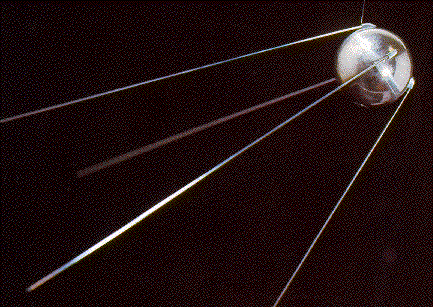
Unfortunately, this was not quite the way things turned out. The only item mentioned in the article that actually got completed during the Five-Year-Plan was the icebreaker Lenin. The next nuclear plant to go into service after Obninsk was in Tomsk in 1958; but these were basically plutonium-production reactors for the weapons program that also produced electricity. The civilian reactors (water-graphite in Beloyarsk and light water at Novovoronezh) began construction in 1957 and 1958 respectively, but only entered service in 1964. But little notice was paid to these failures at the time, given another technological marvel grabbed the world's attention:
Our country stands ahead of other countries in the use of atomic energy for peaceful purposes. In the years of the Sixth Five-Year-Plan the Soviet Union will make a great new leap ahead in the development of atomic technology and in the use of the immeasurable energy of the atomic nucleus.
Subscribe to:
Posts (Atom)